
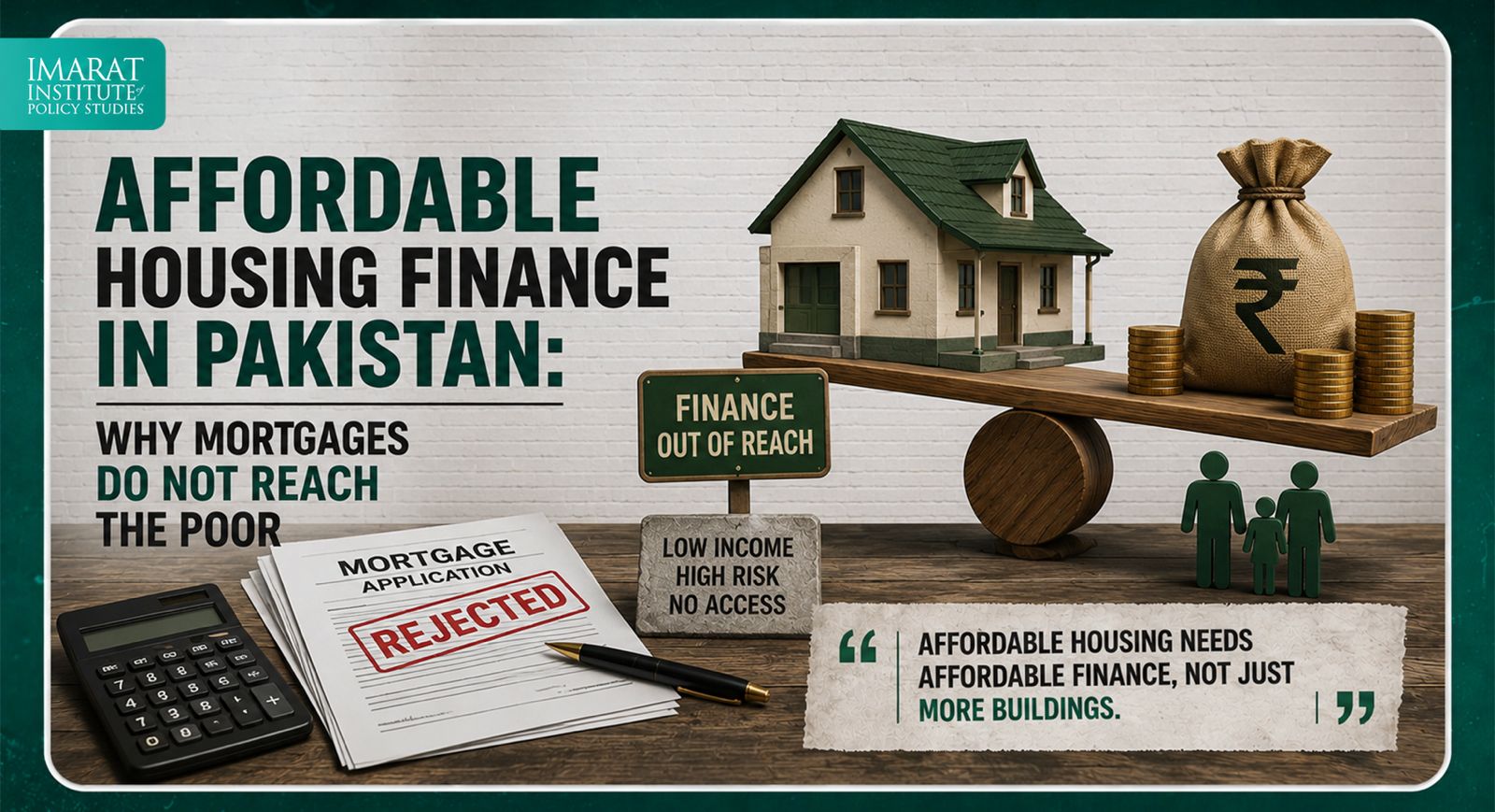
Pakistan’s housing crisis is usually discussed as a shortage of homes, but the deeper issue is that millions of households cannot access the finance needed to buy, build, improve, or rent decent housing. A home is not affordable simply because it is cheaper than other properties in the market. It is affordable when a household can pay for it without sacrificing food, education, healthcare, transport, or basic dignity.
The formal housing finance system in Pakistan remains extremely limited. House Building Finance Company’s 2024 report states that Pakistan’s mortgage-to-GDP ratio has remained below 0.5% for more than a decade, which is very low compared with many Asian housing finance markets (House Building Finance Company, 2024). This shows that formal mortgage finance plays only a small role in helping ordinary households access housing.
The problem is not only the absence of mortgage products. It is that the design of those products does not match the income realities of most Pakistanis. A large share of the population earns through informal, semi-formal, seasonal, daily-wage, or self-employed work. These households may have income, but they often cannot produce salary slips, audited statements, formal tax records, employment contracts, or clear title documents. As a result, they are excluded from housing finance even when they are economically active.
Why Conventional Mortgages Do Not Work for Most Households
Conventional mortgages are built around formal income, long repayment periods, clear property titles, and predictable cash flows. This works for salaried professionals with documented income and legally registered property. It does not work for a shopkeeper with fluctuating monthly income, a domestic worker, a rickshaw driver, a construction labourer, a home-based worker, or a small vendor.
For low-income households, the biggest barrier is not always willingness to repay. It is the gap between how households earn and how banks assess risk. Banks prefer borrowers who are easy to verify. Low-income and informal workers are harder to assess, so they are often treated as high-risk borrowers or excluded altogether.
Property documentation creates another barrier. Mortgage lending depends on secure title, enforceable collateral, and clear land records. Where land titles are disputed, incomplete, informal, or not digitised, banks become cautious. This is why housing finance reform cannot be separated from land record reform.
In 2022, the World Bank approved $435 million in financing for Pakistan projects related to housing finance, property rights, land administration, and affordable housing in Punjab (World Bank, 2022). The structure of that support reflects an important reality: mortgage expansion depends not only on banks, but also on property rights, legal security, and institutional capacity.
The Affordability Problem
Even when mortgages are technically available, they may not be affordable. A household must arrange a down payment, pay documentation and transaction costs, meet monthly instalments, and manage utility and maintenance expenses. When interest rates are high, the monthly instalment rises. When construction costs rise, the loan size required becomes larger. When incomes are unstable, households fear long-term debt.
Pakistan’s housing finance system also tends to support formal home purchase more than incremental building. Yet many Pakistani households build homes gradually. They buy a small plot, construct one room, add another room later, improve the roof, install sanitation, and expand as income allows. This is not a failure of housing behaviour. It is a rational response to limited income and weak credit access.
A better housing finance system would support this pattern safely. Instead of offering only large mortgages for complete homes, financial institutions should also provide smaller loans for home improvement, sanitation, roofing, energy efficiency, flood protection, and incremental construction.
What Pakistan Can Learn from India
India’s Pradhan Mantri Awas Yojana-Urban included a Credit Linked Subsidy Scheme under which eligible households could access interest subsidies through banks and housing finance companies for acquisition or construction of homes (Ministry of Housing and Urban Affairs, n.d.). The model is relevant because it reduces the effective cost of borrowing rather than relying only on direct construction by the state.
Pakistan can adapt the principle, not necessarily the exact design. A targeted interest subsidy can help lower-income households access loans, but only if eligibility is transparent, beneficiaries are properly verified, and banks are willing to lend beyond formal salaried groups. Subsidies should also avoid pushing households into debt they cannot manage.
India’s experience also shows the importance of multiple housing finance channels. Ownership loans, beneficiary-led construction, affordable housing partnerships, and rental housing all serve different needs. Pakistan should avoid treating the mortgage as the only solution.
What Pakistan Can Learn from Bangladesh
Bangladesh offers useful lessons in housing microfinance. The Grameen Bank Housing Programme, launched in 1984, provided small housing loans to poor rural families for stronger homes, with World Habitat noting that loans were used to build more durable houses and were designed around the repayment capacity of poor households (World Habitat, n.d.).
The relevance for Pakistan is clear. Many households do not need a large mortgage immediately. They need Rs. 200,000 to improve a roof, Rs. 300,000 to add a room, Rs. 150,000 for sanitation, or a small loan for flood-resistant improvements. Housing microfinance can support real improvements without forcing households into unaffordable long-term debt.
Microfinance institutions, Islamic finance providers, housing finance companies, and commercial banks can all participate if the regulatory framework supports responsible lending. Products should be designed around cash-flow assessment, not only formal salary documentation.
Designing a Housing Finance System for Pakistan’s Reality
Pakistan needs a layered housing finance system. At the lowest income level, grants and subsidies may be needed for the poorest households, especially those living in disaster-prone or unsafe conditions. For low-income working households, microloans and incremental housing finance can support home improvement. For lower-middle-income households, subsidised mortgages, rent-to-own models, and cooperative housing finance can be useful. For middle-income buyers, mortgage market deepening and fixed-rate products can improve access.
Rental finance should also be part of the solution. Not every household can buy a home, and not every household should be pushed into ownership. Students, workers, young couples, migrants, and temporary urban residents need secure rental options. Developers who build affordable rental housing should receive incentives, but only if rents remain within defined affordability limits.
Islamic housing finance also has a role to play. Products based on diminishing musharakah or ijara structures can appeal to households that prefer Shariah-compliant finance. However, the issue is not only product structure. The real test is affordability, documentation flexibility, and risk management.
Policy Recommendations
Pakistan should begin by expanding alternative credit assessment. Banks should be allowed and encouraged to evaluate borrowers through rent payment history, utility bills, mobile wallet records, business cash flows, remittance records, and community-based verification.
Second, housing finance must be linked to land record digitisation. Clear title reduces lender risk and lowers transaction uncertainty.
Third, the government should support incremental housing finance. Small, purpose-based loans for sanitation, roofing, structural safety, solar systems, and flood resilience may improve living conditions faster than large ownership schemes.
Fourth, subsidies should be targeted and transparent. A subsidy that benefits people who could already afford a home is not affordable housing policy. It is a market distortion.
Fifth, housing finance should support women’s ownership. Joint titles, women-led applications, and inheritance documentation support can improve household security and long-term financial inclusion.
Conclusion
Pakistan’s housing finance problem is not simply that mortgages are unavailable. It is that the mortgage system is too small, too formal, and too disconnected from how ordinary households live and earn. With a mortgage-to-GDP ratio below 0.5% for more than a decade, formal housing finance is not serving the scale of Pakistan’s housing need (House Building Finance Company, 2024).
The solution is not one product. Pakistan needs a complete housing finance ecosystem: micro-mortgages, incremental housing loans, rental housing finance, Islamic products, interest subsidies, credit guarantees, and better land records. Global examples from India and Bangladesh show that finance must be adapted to household realities, not the other way around.
If Pakistan wants affordable housing to move beyond slogans, finance must reach the people who actually need homes. That means designing housing credit for informal workers, lower-income families, renters, and incremental builders. Only then can housing finance become a real tool for inclusion.
References
House Building Finance Company. (2024). Mortgage matters: Exploring housing finance in Pakistan along with Asian countries. House Building Finance Company.
Ministry of Housing and Urban Affairs. (n.d.). Credit Linked Subsidy Scheme: Pradhan Mantri Awas Yojana-Urban. Government of India.
World Bank. (2022, March 10). World Bank supports Pakistan to improve property rights and increase access to affordable housing and mortgage finance. World Bank.
World Habitat. (n.d.). The Grameen Bank Housing Programme. World Habitat.
This article is written by Rehan Zahid. Rehan is a research analyst at the Iqbal Institute of Policy Studies (IIPS).

Leave a Reply