
Preamble
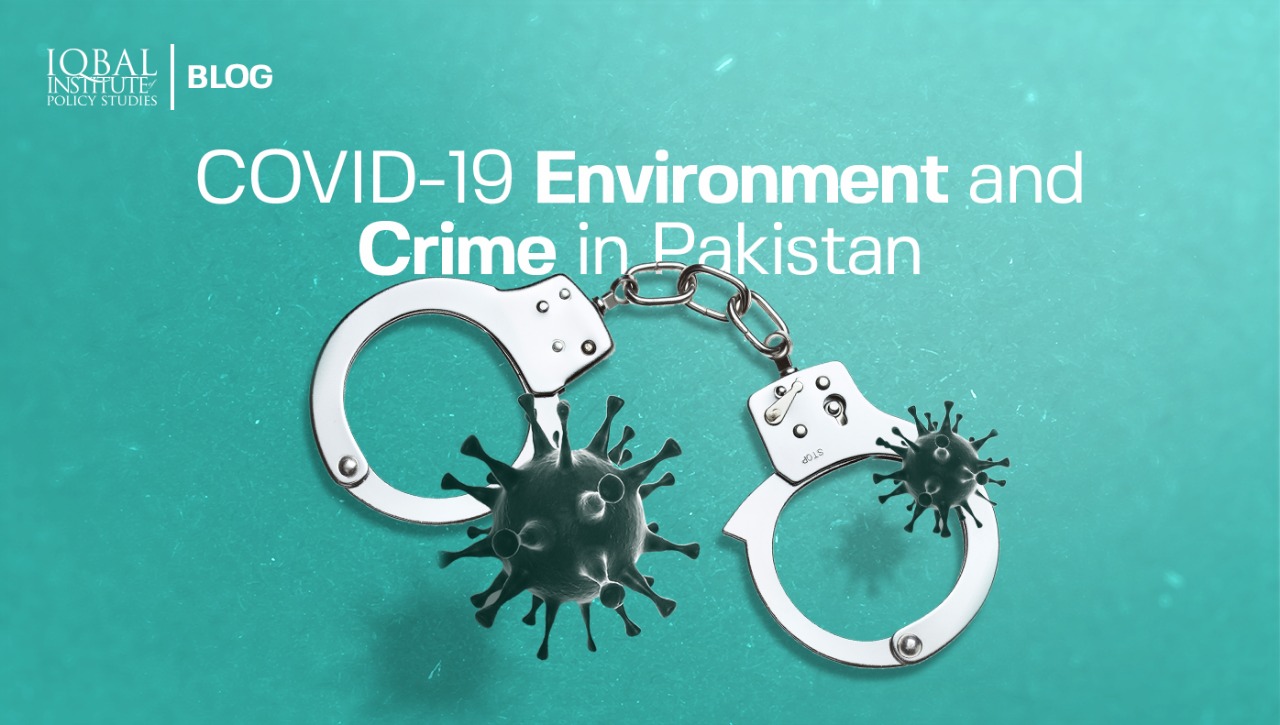
The blog aims to highlight key findings from the webinar conducted on ‘COVID-19 Environment and Crime in Pakistan’ by the Iqbal Institute of Policy Studies. The blog will highlight the various crimes prevalent in Pakistan and how these have been influenced by the pandemic keeping in mind the existing patterns and scale of crime in the country. The capacity of law enforcement agencies in handling the complex situation will also be discussed in light of how the COVID-19 environment impacts the criminal mind. Lastly, measures to control crime will be presented to counter the situation emerging from the COVID-19 pandemic.
Research Questions
- What are the existing patterns of crime in Pakistan?
- What are the major causes of various crimes prevalent in Pakistan and how these have been influenced by the pandemic?
- How the COVID-19 environment impacted the criminal mind?
- What is the capacity of law enforcement agencies to combat crime and handle the complex situation created by the pandemic?
- What measures for crime control can be taken to counter the situation emerging from COVID-19?
Introduction
The COVID-19 pandemic has drastically changed the global law-enforcement landscape, and there is a need to analyse how it might affect crime in Pakistan. With societal injustice increasing, lack of education, scarcity of economic opportunities, rising unemployment, and poverty, the surging crime rate is fast becoming a major concern for Pakistan’s law enforcement agencies. Compounding on the already weak situation, areas like mental health and behavioural pattern disruption is increasingly becoming more relevant in a complex environment of lockdowns and social distancing measures. Use of innovative technologies such as drones and artificial intelligence for effective monitoring, communal policing, proper dissemination of information on COVID-19, and fund allocation for institutions battling crime are required to control the spread of crime in major cities and urban centres. Therefore, COVID-19 has exacerbated the crime situation in Pakistan, and prudent measures need to be taken to control the spread of crime.
Crime in Pakistan: Existing Patterns and Scale of Crime
Pakistan faces a myriad of challenges in the field of law enforcement and crime regulation. According to Lt. Gen. Naeem Khalid Lodhi (Retd), Former Caretaker Defence Minister, social injustice is prevalent in Pakistan, with widespread discrimination in education, housing, employment, healthcare, and transportation. This becomes a significant source of crime and criminal behaviour in society. A lack of education and scarce economic resources aggravates criminal activity due to the incomprehension of laws and poverty. Another important factor that surfaced during COVID-19 is the unprecedented psychological and deteriorated mental health issues faced during lockdowns and social distancing periods. Therefore, the crime rate will increase, but the subsequent reporting may decrease owing to the overburdened registration and investigation process. In conclusion, a spike in crime rate will be seen during the pandemic, which ultimately might become challenging to control.
Impact of COVID-19 Environment on Crime in Pakistan
The impact of COVID-19 can be felt across multiple fronts, which ultimately affect criminal activity in Pakistan. According to Barrister Shahida Jamil, Former Federal Minister of Law, Justice, Human Rights & Parliamentary Affairs, the incidence of COVID-19 patients being mistreated, neglected, and heavily charged in hospitals has circulated on social media platforms, causing unease among the masses. This has resulted in crimes being committed against healthcare staff and doctors all around the country. Another impact is the shift from street crime to domestic crime. “Stay at home” restrictions in some countries have curtailed crime opportunities in public spaces while increasing risks in the domestic sphere. Law enforcement agencies have been distracted due to the added pressure of imposing lockdowns. Lastly, the under-reporting of crimes due to an overburdened registration process will also affect action against criminals. Therefore, the impacts of COVID-19 on crime in Pakistan are significant enough to merit prompt action by the relevant authorities.
According to Mr. Kaleem Imam, Inspector General, National Highway Motorway Police, as soon as the pandemic forced the government to impose a countrywide smart lockdown, the crime rate plunged. The crime against property saw a massive decline owing to the restricted mobility and confinement of people at homes. However, cases of crime against persons, including domestic violence and sexual harassment, soared exponentially. 90% of women in Pakistan have experienced domestic violence from their husbands or families (UNODC, 2020). After the lockdown was eased, the crime rate increased tremendously and is estimated to keep rising due to the disruption of law enforcement agencies. The rising number of COVID-19 cases is putting stress on the already overburdened policing departments. Besides, the impending socio-economic crisis due to COVID-19 is likely to cause a surge in the crime rate due to rising unemployment, inflation, and poverty. The need of the hour is to introduce and spread awareness among the masses about the concept of community policing so that crime can be curtailed.
Criminal Mind Under the COVID-19 Environment
According to Brig. Mowadat Rana (Retd), a seasoned psychiatrist, there is a new trend emerging in Pakistan, whereby people are using COVID-19 as a weapon to commit crimes. Crime is the product of the interaction between the human brain and the environment. A major reason for the increase in crime rate amidst COVID-19 is the confusion and fear created by the spread of misinformation by the media and government officials. There is a need to provide people with clear scientific information regarding COVID-19 to combat fear. Also, the misconception that COVID-19 is a curse from the Divine serves as a trigger for people to commit crimes as they become frustrated and hopeless. An unhealthy mind is more susceptible to crimes. Criminals are exceptionally creative, and in the face of challenges imposed by COVID-19, criminals will come up with innovative ways to commit crimes. There will be a surge in cyber-crime as more people will use the internet. Online sex trade, Sexual harassment, and rape cases might increase due to increased frustration. Drug trafficking will increase with an online delivery mechanism in place. Crimes such as overpricing and price fixing will increase, especially in the pharmaceutical and medical industry. COVID-19, therefore, will leave a lasting impact on the criminal mind in the generations to come.
The Capacity of Law Enforcement Agencies to Combat Crime
Law enforcement agencies in Pakistan face multiple challenges in combating rising crime during the COVID-19 pandemic. Pakistan developed a National Plan of Action (NPA) for coordinating an emergency response to mitigate the effects of the pandemic on social security, but it has largely been silent on the issue of capacity building for the police. The police have frequent interactions with the public and therefore, the risk of contracting the virus is greater. Lack of adequate personal protection equipment (PPE), poor health coverage for officials, and serious lack of funds add to the burden of containing crime during a pandemic. The government needs to issue standardized guidelines and provide additional funds for the police to help them meet the challenge successfully while maintaining personal safety (UNODC, 2020). Leadership from the provincial police departments have issued new SOPs for dealing with COVID-19 but a nationwide approach is required to ensure universal application of standards in line with the principles of WHO. Due to a rise in domestic crimes in face of lockdowns, a need for an online portal for registration of complaints is also felt. Therefore, the law enforcement agencies in Pakistan were underprepared for the pandemic in light of diminishing resources and capacity.
Measures to Control Crime and Counter the Situation Emerging from COVID-19
The need of the hour is to introduce and spread awareness among the masses about the concept of community policing so that crime can be curtailed. Police leadership should communicate clearly and frequently with the staff about COVID related policies and procedures. All officers should be trained on proper wearing, removal, and disposal of personal protective equipment. A contingency plan should also be developed to cater to staffing shortages. Lastly, provincial and local governments and the private sector should pay special attention to the rise of gender-based violence against women as they are the most affected group during a pandemic.
Conclusion
The COVID-19 pandemic has given rise to multiple factors that become a cause for increased crimes and criminal mentality. Pakistani society is gripped in social and economic challenges, which further add to criminal behaviour. Due to a strong institutional response and increased mobilization of resources, it is hoped that Pakistan will emerge triumphant in controlling the spread of crime and criminal mentality during the COVID-19 pandemic.
Bibliography
Iqbal Institute of Policy Studies. (2020). Covid 19 Environment and Crime in Pakistan. Islamabad: IIPS. Available at https://www.facebook.com/144287616215098/videos/595735891325025
UNODC. (2020). Police and COVID-19, PAKISTAN’S PREPAREDNESS FOR THE NEW NORMAL. Retrieved from UNODC: https://www.google.com/url?sa=t&rct=j&q=&esrc=s&source=web&cd=&ved=2ahUKEwiQpOW3tvfsAhUBYcAKHQNYCvUQFjAAegQIARAC&url=https%3A%2F%2Fwww.unodc.org%2Fdocuments%2Fpakistan%2F%2F005-UNODC_AdvocacyBrief5_POLICE-PAKISTAN.pdf&usg=AOvVaw0liw4suiiV3ZMmHduN4P09

Leave a Reply