
There is no doubt that a healthy population is a nation’s most significant asset for it is valuable and adds value to society. In addition to being a direct source of human welfare, health is also one of the most effective methods for raising income levels. There are still significant development challenges facing Pakistan’s health sector, including poverty, insufficient resources, shifts in the spectrum of diseases, malpractices, and a lack of health information, which contribute to poor health outcomes. The Sustainable Development Goals (SDGs) place a great deal of emphasis on health and well-being. “Ensure healthy lives and promote well-being for all ages” is the third Sustainable Development Goal. The overall score of Pakistan’s SDGs Index has increased from 53.11 in 2015 to 63.5 in 2020, which is an increase of 19.5 percent from the baseline score of 2015. In terms of three out of 14 indicators, Pakistan is on track to meet three of them including the Maternal Mortality Rate, the number of new HIV infections, and the number of births attended by skilled medical personnel. As far as all other indicators are concerned, they are either moderately improving or stagnating.
It has been reported that the Infant Mortality Rate (IMR) in Pakistan has declined from 55.7 deaths per 1,000 live births in 2019 to 54.2 deaths per 1,000 live births in 2020, whereas the Neonatal Mortality Rate has decreased from 41.2 deaths per 1,000 live births in 2019 to 40.4 deaths per 1,000 live births in 2020. There was an increase of 69.3 percent in the number of births attended by skilled health personnel in 2020, compared to 68.3 percent in 2019. During the year 2020, the rate of maternal deaths per 100,000 live births dropped to 186, a change from the rate of 189 in 2019. Despite a population growth rate of 2 percent per year, Pakistan’s contraceptive prevalence rate has decreased from 34 percent in 2019 to 33 percent in 2020, a decrease of 10 percent over the previous year. The prevalence rate of tuberculosis in Pakistan is 259 per 100,000 population, while the prevalence rate of HIV is 0.12 per 1,000 population.
Childhood health can have a direct effect on cognitive development and the ability to learn. In addition, because adult mortality and morbidity (sickness) can lower the prospective returns to investments in schooling, improving adult health can raise the incentives to invest in education. Similarly, a longer prospective lifespan can increase the incentive to save for retirement, generating higher levels of savings and wealth, and a healthy workforce can increase the incentives for business investment. A population’s health also affects population numbers and age structure. The economic effects of population health can be seen both at the individual and macroeconomic levels. Women and children in Pakistan continue to be among the most malnourished in the world, both in terms of the percentage as well as the absolute number of malnourished. In addition to this, there is also an increasing and changing demand for health services as a result of factors such as demographics, urbanization, and climate change, which are all influencing the demand for health services. There is a limited fiscal space in the country as a result of the low tax-to-GDP ratios which limits the government’s ability to turn this growth into revenue for the people. There is a low level of public spending on health when compared to other countries in the world. There are a lot of patients who are paying out of their own pockets to access medical services. Poor people are being pushed further into poverty because of the high costs of health care.
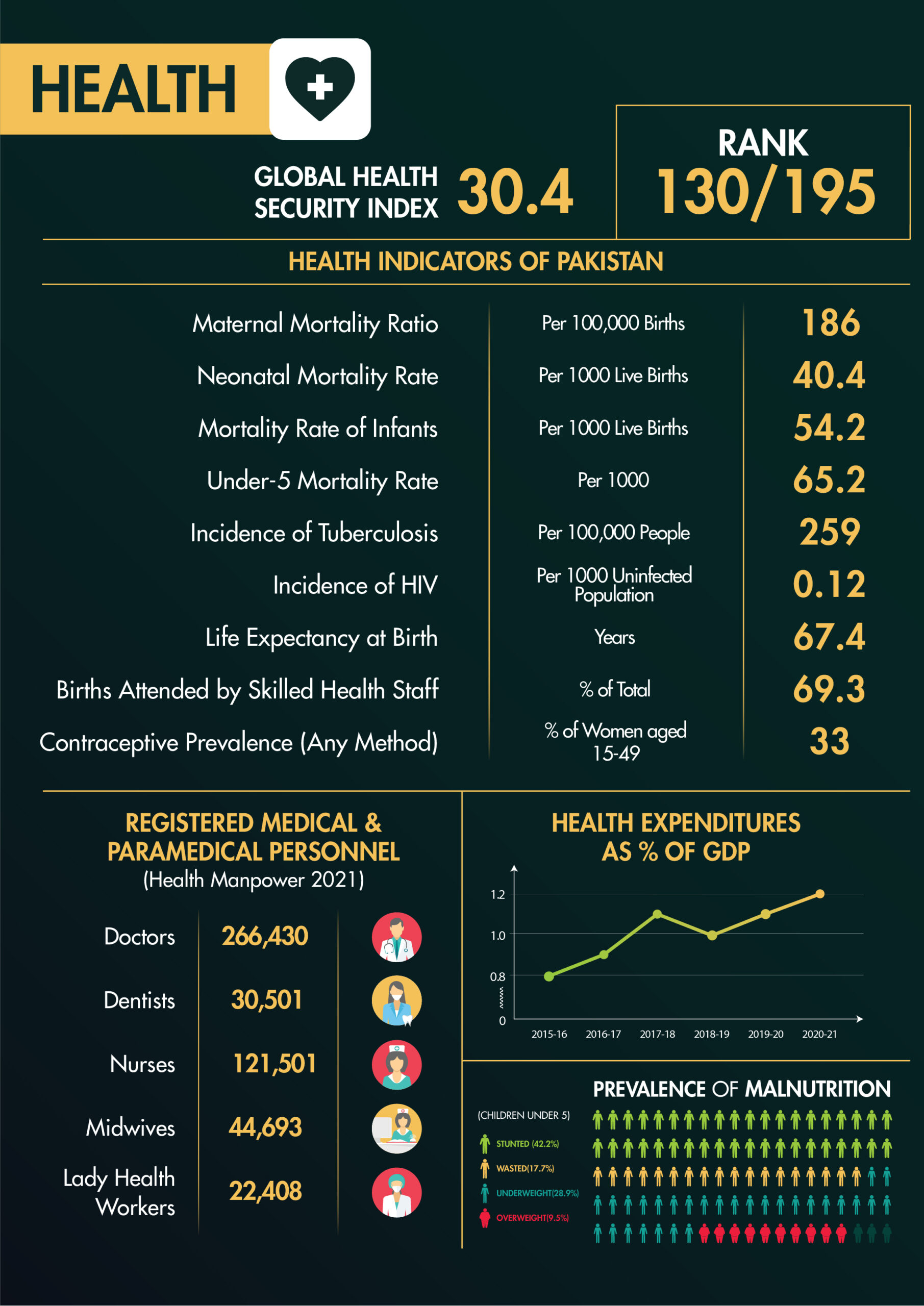
- Health Indicators of Pakistan
There has been steady progress in Pakistan’s economic development over the years. However, with the country’s growing economic strength and population, the health sector has not been able to keep pace with its growing needs. There have been significant improvements in the maternal mortality ratio as well as the under-5 mortality rate. Despite this, Pakistan’s life expectancy remains lower than that of countries of a similar level of development. If children are malnourished and do not grow into healthy young adults in Pakistan, the benefits of the demographic A HEALTHY NATION 22 dividend would be impaired. Health outcomes are better in countries that are much poorer than Pakistan. Aside from that, it is imperative to keep in mind that health outcomes are not just a function of healthcare but also of access to water and sanitation, as well as the education of mothers, the importance of nutrition, and many other factors.
Vision Pakistan 2047 envisions a comprehensive and equitable healthcare system that covers all of Pakistan, with the participation of the government, the private sector, and civil society alike. There should be coverage of all medical specialties as well as specialized medical institutes and universities to develop human resources with a variety of specializations. The desired healthcare system must be based on international best practices in accreditation, whether this is for medical services, hospitals, laboratories, or medical personnel involved in the healthcare system. To redefine the relationship between citizens and healthcare institutions, a new culture surrounding healthcare needs and practices must be developed. Awareness of health issues plays a key role in ensuring the delivery of medical services, preventing diseases, ensuring communication, and raising public awareness about health issues as well. Technology must also be considered a vital instrument to assist in overcoming geographical and distance barriers in the delivery of world-class health services to all citizens and residents of Pakistan.
Vision Pakistan 2047 promotes a strategy of public-private partnership by promoting the private supply of health services for most of the population while also enforcing accountability for quality service delivery to prevent willful negligence, and focusing on public supply for the rural communities, areas not served well by the private sector and on urban poor; on mass communicable diseases; on health research and training based on a system of high quality public national hospitals; and on nutrition programs. Following are the key reform areas where Pakistan must focus its efforts to achieve a world-class health system.
Communicable and Non-communicable Diseases
Pakistan is currently facing the double burden of communicable (42 percent) and non-communicable diseases (58 percent), according to WHO NCD Country Profiles 2018. About 58 percent of all deaths are attributed to NCDs and the country is transitioning with NCDs dominating over communicable diseases. While the latter is due to a lack of availability of safe drinking water, sanitation, under-nutrition, poor living conditions, poor implementation of public health programs, and limited access to preventive and primary health care, the former is due to lifestyle changes and demographic transitions. Pakistan must devise a strategy to reduce the overall burden of diseases by half through targeted national programs to end the epidemic of common communicable diseases and reduce the burden of common NCDs with early detection and effective management.
Increase Public Spending on Healthcare and Improve Overall Infrastructure
The existing health infrastructure in Pakistan, in terms of capacity and human resources, is inadequate to meet the needs of a growing population. Public healthcare institutions suffer from inadequate spending and capacity constraints. This has resulted in too many people turning to private healthcare service providers, which also exhibits variation in the quality of services and the charges for different services. The central and state governments must offer healthcare services, free treatment, and essential drugs at government hospitals to the poor and deserving while ensuring that the vulnerable groups in society are catered for.
Pakistan has grossly under-invested in its primary healthcare sector. The rising cost of treatment in Pakistan is also leading to inequity in access to healthcare services. Providing a public health insurance scheme can be a game changer and pave the way for the transformation of healthcare access in Pakistan. Effective implementation of universal health coverage would require extensive investments from the public and the private sector for infrastructure expansion and strengthening the healthcare workforce.
With limited public funds, the government must provide appropriate incentives to channel private investment in targeted areas. Given the low public spending on healthcare and the rising population, the healthcare sector should provide appropriate financing options, incentives, and tax benefits to the private sector.
Strengthening Healthcare Workforce
Growing demand for adequate healthcare requires an adequate supply of healthcare professionals, especially doctors and nurses. A strategy for higher investment in public and private medical education, stronger training including through the public national research and teaching, instituting health information and exchange and online training with international medical universities, and inviting international health experts for imparting national training must be devised. Pakistan fares poorly in the doctor-to-patient ratio, with a shortage of nurses at primary and community healthcare centers. There is an urgent need to upgrade district hospitals to medical colleges in rural and semi-rural areas through public-private partnerships or public spending to increase and strengthen the healthcare workforce of Pakistan. The government must also incentivize all tertiary care hospitals for specialists and allied workforce training by encouraging training facilities as a part of project design for new hospitals. It must create provisions for private medical colleges to partner with public and private hospitals for medical education by optimizing existing resources and avoiding duplication. The government must formally recognize existing alternatives used by the healthcare sector to train and upskill healthcare professionals and upgrade the nursing curriculum and faculty along with the implementation of competency-based education and licensing exams. Additionally, the public sector must expand healthcare skill sets to include more allied healthcare professionals such as physicians, assistants, nursing aides, and technical assistants to help evenly distribute the burden of the healthcare workforce. Guidelines and standardized protocols need to be formulated along with a strong training and development framework to accentuate the role of these professionals.
Improve the Quality of Healthcare Delivery
The quality of healthcare and clinical service delivery has not gained adequate importance in healthcare programs in Pakistan. The government of Pakistan must encourage public health facilities across the country to apply for quality assurance programs. The aim should be to promote and incentivize improved patient outcomes across public and private providers with standardization in clinical practice.
Use of Technology to Enhance Reach and Outcomes
Technology can be leveraged to improve healthcare in Pakistan and improve health outcomes. Telemedicine initiatives must be started to reach remote areas in the country. Healthcare providers should also explore other innovative technology-enabled solutions for expanding access and quality of care – from technology-enabled smart hospital rooms and advanced diagnostics to therapeutic care facilities supported by evidence-based advanced clinical decision support. Innovative out-of-hospital care models must be developed to reduce average hospital stay length. It would not only reduce costs but also improve the availability of healthcare services to more people.
The paper-based record-keeping system often delays access to records and diagnosis, thus impacting the quality of healthcare services. The rolling out of the National Health Database, using a standardized, integrated, and interoperable system, would ensure the availability of centralized healthcare information. Investing in exponential technologies will help reduce costs, increase access, and improve care for patients. Artificial intelligence (AI), robotics, 3D printing, and synthetic biology can radically disrupt the system. Healthcare providers should also set aside a budget for innovations, and the government can also consider setting up special clusters/ zones for advanced medical technology development, research, and innovation.
Regulatory Reforms and Transparency
The government should play the role of facilitator, and regulations should not be restrictive for the sector’s growth. Currently, there are multiple licenses required to set up a hospital. The government needs to consider a single-window clearance system for granting licenses and approvals and take up the role of a facilitator.
Create a Robust Healthcare ecosystem by Strengthening Allied Sectors
With the underlying objective of providing access to affordable healthcare, medicines, and good hygiene, targeted interventions are required in allied sectors such as pharmaceuticals, medical devices, alternative healthcare, and sanitation.
Pharmaceutical
Regarding medicine availability, access to life-saving drugs remains a challenge in Pakistan. Self-reliance on major and crucial Active Pharmaceutical ingredients (APIs) is essential for national health security. Policy measures related to process, infrastructure, and fiscal benefits need to be taken by the government to ensure the development of local medicines instead of imported ones. In addition, an ecosystem should be developed to spur R&D and innovation in Pakistan.
MedTech
Pakistan is the 54th largest importer of medical equipment in the world. There is a need to outline a long-term vision and roadmap for the MedTech industry, clearly separating medical devices from drugs, to make Pakistan one of the world’s top five medical device markets and manufacturing hubs. Also, there is a need to enhance and promote investment in R&D and innovation and drive skill-up gradation in the MedTech sector.
Medical Value Travel
Pakistan should position itself as the most preferred destination for medical value travel by leveraging the availability of quality, high-end tertiary care at fractional prices. Income from the services provided by healthcare providers to foreign nationals in Pakistan who come for medical treatment should be treated as an export of services.
Water and Sanitation
Pakistan faces a huge challenge in providing effective sanitation coverage and safe drinking water access to large sections of 25 its population. There is a strong need to align various government programs and policies at the grassroots level. It is important to bring behavioral changes among people. The government needs to come out with a comprehensive sanitation policy at the national level so that it covers both liquid and solid waste and lays out clear guidelines for its implementation.
Expand Public Health Clinics and Improve Quality
Pakistan must strengthen and upgrade rural health clinics; extend health clinics to areas that are not well served by private supply; and introduce public health clinics for the urban poor. The quality of these clinics must be upgraded through appropriate staffing and supply of essential medicines. Taking advantage of modern technology, these clinics must be linked up with national research hospitals for e-consultations for high-risk cases. Public hospitals at the district level must be strengthened to ensure access to proper medical care for those who cannot afford private hospital care or do not have access to national hospitals owing to capacity constraints. Given the growing share of an ageing population, emphasis must be given to developing the capacity to handle geriatric patient care. Emphasis should be placed on strengthening all existing national hospitals for quality teaching and research and the treatment of complex health cases.
Eliminate Child Nutrition Gaps
Strong efforts must be made to strengthen public nutrition support programs through adequate staffing and resources to eliminate the incidence of stunting and waste by 2047. The nutrition education campaign must be strengthened in partnership with NGOs to reach out to children in hard-to-reach areas, children of poor rural families, and children in the urban slums.
Strengthen Private Health Care Delivery System
The private sector plays a major role in curative health care delivery. This system will be strengthened through flexible licensing, promoting FDI in health care including flexible policies for the use of international healthcare professionals, ensuring full compliance with government regulations relating to the quality of care and rights of patients, and ensuring accountability for willful negligence in service delivery.
Introduce Health Insurance Schemes
Curative health care is expensive and health shocks are an important reason for pushing the borderline poor back into the poverty trap. So, the development of a proper health insurance system is necessary. Pakistan must establish this system with a balanced combination of private supply of health insurance programs and public financial support for insurance schemes for the poor and vulnerable population. Public health insurance support programs should be a part of the social protection program of the government and access to these schemes will follow the same principles as access to other social protection schemes. A sound health insurance system is essential to achieve the SDG target of universal health care.
Strengthen Health Sector Governance
Pakistan must strengthen and enhance the regulatory functions and supervisory role of the Ministry of Health (MOH) including the agencies under it by increasing the capacity of the relevant bodies and establishing/updating standards and accreditation systems and legal frameworks to ensure quality healthcare services including drug administration in both public and private sectors.
Improve Health Information Systems
Pakistan must improve the health MIS by scaling up the routine health information system along with e-Health, timely qualitative reporting from all reporting units of both public and private sectors, capacity building of health managers, and appropriate use of information technology. The generation of information flow and the use of authentic data will be the key to success. The full potential of ICT will need to be explored to ensure an improved health system suited to the needs of an HIC.

Leave a Reply