
Pakistan’s cities are growing faster than their planning systems. Housing demand is rising. Informal settlements are expanding. Land prices are increasing. Roads are congested. Public services are under pressure. Climate risks are intensifying. Yet urban governance remains fragmented across development authorities, municipal bodies, provincial departments, cantonments, utility agencies, revenue departments, and private housing societies.
This fragmentation is now an economic problem. Cities are supposed to create productivity through concentration: people, firms, workers, universities, services, transport, finance, and innovation all coming together. But when cities become congested, unaffordable, polluted, and poorly serviced, the benefits of urbanisation weaken.
UNDP Pakistan states that, according to the 2017 Census, 36.4% of Pakistan’s population lived in urban areas, up from 32.5% in 1998, while alternative estimates suggest the urban share may be 40.5% or higher (UNDP Pakistan, 2018). UN-Habitat notes that Pakistan’s urban population almost doubled from 43 million to 75 million between 1998 and 2017, and could reach an estimated 118 million by 2030 (UN-Habitat, n.d.). These figures show that Pakistan’s urban challenge is not temporary. It is the country’s development future.
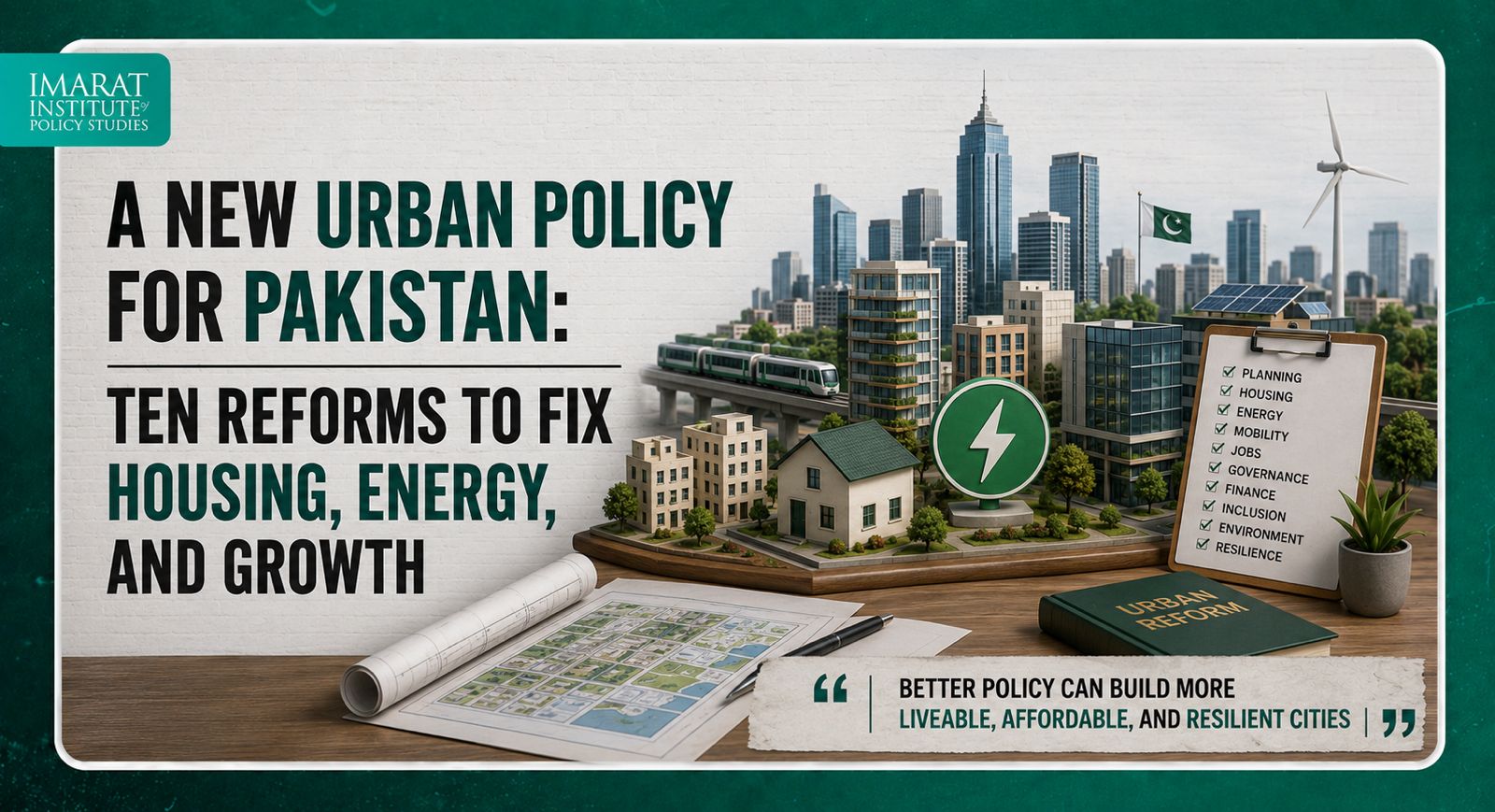
Pakistan needs a new urban policy built around ten practical reforms.
1. Create Integrated Metropolitan Governance
Large urban regions do not stop at municipal boundaries. Lahore, Karachi, Islamabad-Rawalpindi, Faisalabad, Peshawar, Multan, Hyderabad, and Quetta all function through wider metropolitan systems. Housing, transport, jobs, land markets, water, waste, and air pollution cross administrative lines.
Pakistan needs metropolitan-level coordination authorities that can align transport, land use, housing, environment, infrastructure, and economic development. These bodies should not replace local governments, but they should coordinate across fragmented agencies.
2. Reform Land Records and Property Data
Real estate cannot mature without transparent land records. Weak records create disputes, under-declaration, mortgage barriers, fraud, and speculative pricing. Pakistan should digitise land ownership, cadastral maps, building approvals, zoning status, rental data, and transaction records.
The World Bank’s support for property rights, land systems, housing finance, and affordable housing in Pakistan reflects the importance of connecting land administration with housing and finance reform (World Bank, 2022).
3. Shift from Sprawl to Planned Density
Pakistan’s cities are expanding outward through housing societies, peri-urban land conversion, and informal growth. This increases infrastructure costs and commute burdens. Planned density around transport corridors, employment zones, and existing infrastructure can make cities more efficient.
Density should not mean random high-rises. It should mean medium-rise and high-rise development where utilities, roads, public transport, fire safety, and public space can support it.
4. Make Affordable Housing a Land Policy Issue
Affordable housing cannot be solved only through construction. It requires land. Public land, transit-adjacent land, and underused urban land should be mapped and linked to affordable housing goals. Developers receiving density bonuses or public infrastructure support should provide affordable units or contribute to affordable housing funds.
5. Formalise Rental Housing
Ownership alone cannot solve Pakistan’s housing crisis. Students, workers, migrants, young families, and low-income urban residents need secure rental options. Pakistan should standardise rental contracts, digitise lease registration, protect tenants and landlords, and incentivise build-to-rent housing near universities, hospitals, industrial zones, and transit corridors.
6. Connect Transport and Real Estate
Public transport should shape city growth. Metro, BRT, and bus corridors should be surrounded by mixed-use, walkable, higher-density development. Pakistan should introduce transit-oriented development zones with affordable housing, pedestrian access, parking control, and commercial activity.
The World Bank’s South Asia urbanisation work recommends forward-looking planning, stronger connectivity, improved public spaces, and more flexible land-use planning to improve prosperity and liveability (World Bank, 2015). These principles apply directly to Pakistan.
7. Build Climate-Resilient Cities
Flooding, heatwaves, water stress, and air pollution are now central urban risks. ADB’s Pakistan National Urban Assessment notes that failing public services, inadequate planning, insufficient housing, and climate risks are contributing to declining quality of life in Pakistan’s cities (Asian Development Bank, 2024).
Cities should require flood-risk mapping, water-sensitive design, tree cover, heat action plans, drainage protection, rainwater harvesting, and climate-resilient building standards.
8. Improve Municipal Finance
Cities need money to provide services. Property taxes, development charges, parking fees, service charges, and land value capture should be modernised. But revenue must be linked to service delivery. Citizens are more willing to pay when they see cleaner streets, better drainage, safer roads, and reliable public services.
Municipal finance reform should include transparent budgets, digital payments, performance dashboards, and local reinvestment of revenue.
9. Regulate Private Housing Societies Better
Private housing societies are major city-builders in Pakistan, but regulation is uneven. Approvals should require verified land ownership, infrastructure plans, water supply, drainage, wastewater treatment, public amenities, road access, energy planning, and consumer protection.
No project should be marketed before legal approval is clear. Buyers must be able to verify project status online.
10. Use Data for Urban Decision-Making
Pakistan needs city-level urban observatories. These should track housing demand, land prices, rents, transport use, building approvals, water stress, waste collection, air quality, flood risk, and public service performance. Policy without data becomes guesswork.
Digital tools should support transparency, not only surveillance. Open data can help researchers, investors, planners, and citizens understand how cities are changing.
Conclusion
Pakistan’s economic future depends on its cities. If cities remain congested, unaffordable, under-serviced, and climate-vulnerable, national productivity will suffer. If cities become better planned, better financed, more inclusive, and more resilient, they can drive growth.
A new urban policy must connect housing, land, transport, energy, water, climate, real estate, finance, and governance. The reforms are not impossible. They require coordination, transparency, and political seriousness.
Pakistan does not need more fragmented urban announcements. It needs a practical national urban reform agenda with provincial implementation and city-level accountability. The goal should be simple: cities that are affordable to live in, efficient to work in, safe to move through, and resilient enough to survive the future.
References
Asian Development Bank. (2024). Pakistan national urban assessment: Pivoting toward sustainable urbanization. Asian Development Bank.
UNDP Pakistan. (2018). Sustainable urbanization. United Nations Development Programme.
UN-Habitat. (n.d.). Urbanization in Pakistan: Building inclusive and sustainable cities. United Nations Human Settlements Programme.
World Bank. (2015). Leveraging urbanization in South Asia: Managing spatial transformation for prosperity and livability. World Bank.
World Bank. (2022, March 10). World Bank supports Pakistan to improve property rights and increase access to affordable housing and mortgage finance. World Bank.
This article is written by Shahmeer Adnan Baloch. Shahmeer is a research analyst at the Iqbal Institute of Policy Studies (IIPS).

Leave a Reply