
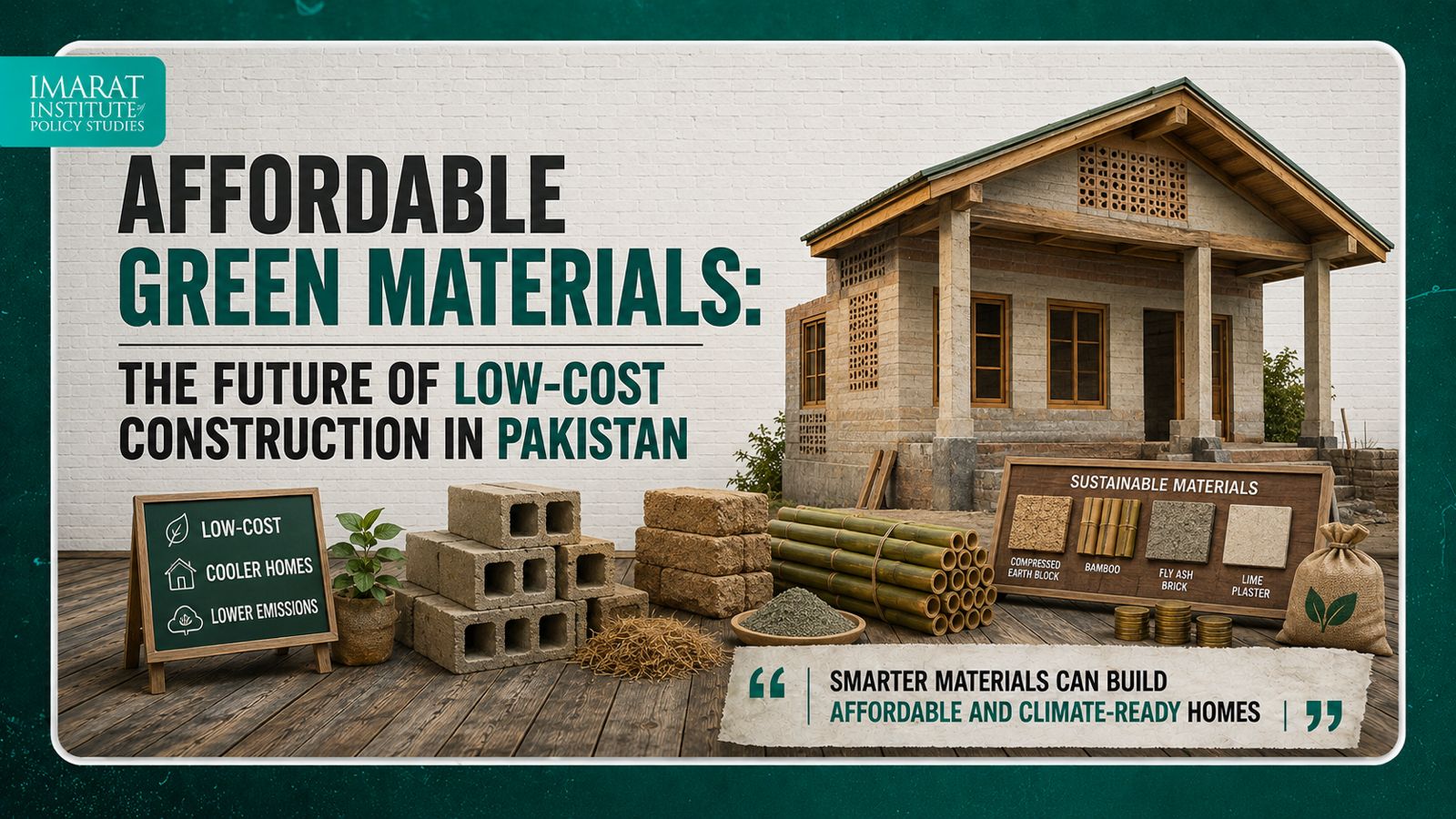
Pakistan’s construction sector faces a difficult challenge. The country needs millions of better homes, stronger infrastructure, climate-resilient reconstruction, and more affordable buildings. At the same time, construction costs are rising, energy is expensive, cities are heating up, and climate risks are increasing. The country cannot solve its housing and infrastructure needs by simply using more of the same materials in the same way.
Affordable green materials offer a practical path forward. These include materials and systems that reduce environmental impact, improve thermal comfort, lower energy demand, use local resources efficiently, and remain affordable for ordinary households. The goal is not to make every building expensive and high-tech. The goal is to build smarter, safer, cooler, and more efficiently.
Globally, the need is urgent. UNEP’s Global Status Report for Buildings and Construction states that buildings and construction accounted for about 37% of energy and process-related carbon dioxide emissions in 2022, while buildings were responsible for 34% of global energy demand (UNEP, 2024). This means construction material choices are not only local cost decisions. They are climate decisions.
For Pakistan, green materials must be judged by three questions: Are they affordable? Are they safe? Do they improve performance in local climate conditions?
Why Conventional Materials Are Under Pressure
Cement, steel, fired bricks, concrete blocks, glass, tiles, aluminium, and imported finishing materials dominate formal construction. These materials are useful and often necessary, but they can be expensive, energy-intensive, and poorly suited to thermal comfort when used without good design.
Fired clay bricks, for example, require fuel and can contribute to air pollution when produced in inefficient kilns. Concrete and steel are essential for structural safety but have high embodied energy. Large glass façades may look modern, but in Pakistan’s climate they can increase heat gain and cooling demand.
The issue is not that conventional materials should be abandoned. The issue is that they should be used more intelligently, combined with alternatives where suitable, and supported by better design. A low-cost house should not become unsafe in the name of sustainability. A green material is only useful if it performs well, can be maintained, and meets safety standards.
Local and Climate-Responsive Materials
Pakistan has a long tradition of climate-responsive construction. Courtyards, verandas, thick walls, shaded openings, lime plaster, mud construction, brick jaalis, high ceilings, and local materials were historically used to manage heat, privacy, and ventilation. Modern construction often replaced these strategies with flat concrete roofs, poor insulation, sealed rooms, and heat-absorbing surfaces.
Affordable green construction can learn from traditional methods while applying modern engineering. Stabilised earth blocks, compressed earth blocks, improved mud construction, lime-based materials, bamboo systems, stone, and low-carbon brick alternatives can be useful in specific contexts. Their use should depend on climate, soil, structural needs, flood risk, seismic risk, and availability.
UNESCO has documented the work of Pakistani architect Yasmeen Lari, who has designed flood- and earthquake-resistant houses using traditional bamboo and mud construction techniques after the 2022 floods (UNESCO Courier, 2024). Her work is important because it demonstrates that low-cost local materials can be used for resilience when combined with technical knowledge and community training.
Bamboo, Earth, and Flood-Resilient Design
Bamboo is lightweight, fast-growing, and flexible. In Pakistan, it has been used in low-cost and emergency construction, especially when guided by skilled design. But bamboo is not automatically safe. It must be treated, connected properly, protected from moisture and pests, and designed according to structural requirements.
Earth-based construction can provide thermal comfort because thick earthen walls can reduce heat transfer. However, untreated mud walls may be vulnerable to flooding and erosion. Stabilisation, raised plinths, protective plasters, roof overhangs, and drainage are essential.
This is the central lesson for Pakistan: green materials must be part of a system. A bamboo wall, compressed earth block, or alternative brick is only as good as the foundation, roof, drainage, treatment, and workmanship around it.
Fly Ash Bricks and Industrial By-Products
Fly ash bricks are another potential alternative. Fly ash is an industrial by-product that can be used in bricks, blocks, pavers, and concrete products. Some Pakistani suppliers already market fly ash bricks as alternatives to burnt clay bricks, citing uses in housing and building construction. However, broader adoption requires testing, standards, availability, and buyer confidence.
The advantage of using industrial by-products is that waste can be converted into construction value. The risk is quality inconsistency. If materials are not properly tested for strength, durability, water absorption, and safety, they can fail in real buildings.
Pakistan should therefore develop certification systems for alternative materials. Builders should not have to guess whether a product is safe. Certified materials can help green construction move from niche experimentation to mainstream use.
Thermal Comfort and Lifetime Affordability
Affordable housing should not be judged only by construction cost. It should also be judged by lifetime cost. A house that is cheap to build but extremely hot in summer forces families to spend more on fans, coolers, or air conditioning. A poorly insulated roof can increase electricity use for decades.
Green materials can improve affordability by reducing energy demand. Roof insulation, reflective coatings, ventilated roofs, cavity walls, shaded windows, and thermally efficient blocks can reduce heat gain. These features are especially important in cities such as Multan, Jacobabad, Lahore, Karachi, Hyderabad, Sukkur, and Bahawalpur.
Government-backed housing programmes should include minimum thermal comfort standards. Low-income families should not be left with the hottest and least efficient homes.
Policy Recommendations
Pakistan should create a national green material testing and certification programme. Universities, engineering councils, material laboratories, and building authorities can test alternative bricks, blocks, insulation systems, bamboo components, recycled materials, and low-carbon products.
Second, affordable housing schemes should include approved green material options. Developers should be able to use certified alternatives without facing approval uncertainty.
Third, local material industries should receive support to modernise. Cleaner brick kilns, fly ash brick production, recycled aggregate processing, and low-carbon cement alternatives can reduce environmental impact.
Fourth, disaster reconstruction should use resilient local materials where suitable. Flood zones, earthquake zones, and heat-prone areas need different material strategies.
Fifth, buyers should be educated about lifetime affordability. A cooler, better-insulated house may save more money over time than a cheaper but inefficient structure.
Conclusion
Pakistan needs construction materials that are affordable, safe, climate-responsive, and environmentally responsible. Green materials should not be treated as luxury products for elite projects. They should be central to affordable housing, flood reconstruction, schools, clinics, tourism facilities, and rural homes.
The global building sector is a major source of energy use and emissions, and Pakistan cannot ignore this reality. But the country’s solution must be local. Bamboo, earth, improved brick systems, recycled materials, fly ash products, insulation, and passive design can all contribute if tested and used properly.
The future of low-cost construction in Pakistan is not about choosing between affordability and sustainability. It is about combining both. A truly affordable home is one that is safe to build, cheap to maintain, comfortable to live in, and resilient to climate pressure.
References
UNEP. (2024). Global status report for buildings and construction: Beyond foundations: Mainstreaming sustainable solutions to cut emissions from the buildings sector. United Nations Environment Programme.
UNESCO Courier. (2024). Bamboo houses mitigate the effects of climate change in Pakistan. UNESCO.
World Bank. (2024). Pakistan: World Bank approves $450 million additional financing to further support resilient reconstruction in response to the 2022 catastrophic floods. World Bank.
This article is written by Shahmeer Adnan Baloch. Shahmeer is a research analyst at the Iqbal Institute of Policy Studies (IIPS).

Leave a Reply