
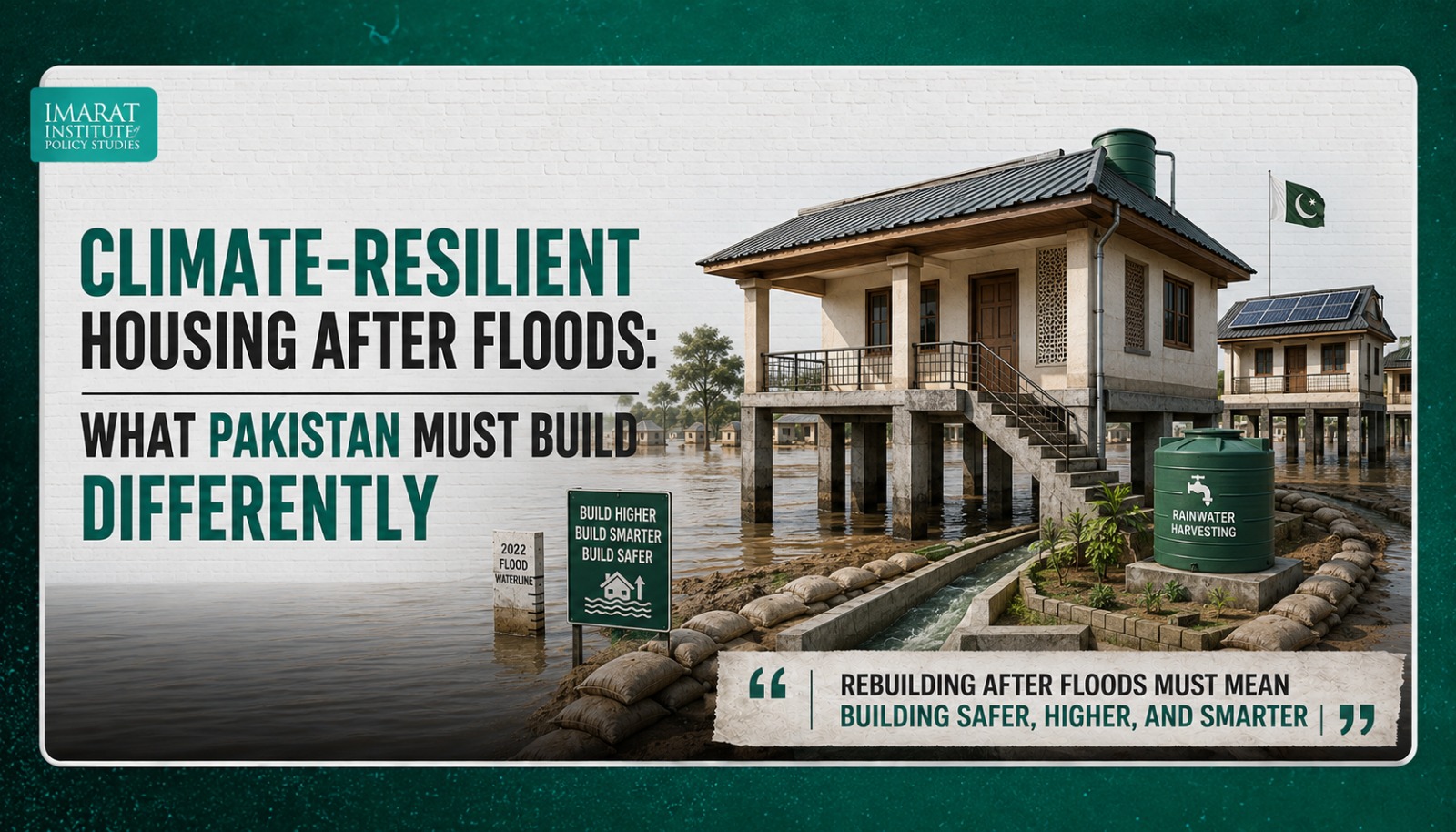
Pakistan’s flood recovery must move beyond rebuilding damaged homes. Climate-resilient housing can reduce future losses, protect livelihoods, and make vulnerable communities safer.
Introduction
Pakistan’s 2022 floods were not only a humanitarian disaster. They were a housing disaster. Millions of people lost homes, land, livestock, income, and basic security. The Post-Disaster Needs Assessment prepared by the Government of Pakistan with support from the Asian Development Bank, European Union, United Nations agencies, UNDP, and the World Bank estimated total damages at over USD 14.9 billion and economic losses at around USD 15.2 billion (Government of Pakistan et al., 2022). The World Bank also reported that overall reconstruction needs exceeded USD 16 billion and emphasised a “build back better” recovery based on climate resilience, inclusion, transparency, and prioritising the poor (World Bank, 2022).
For Pakistan, this is a turning point. Rebuilding the same type of housing in the same vulnerable locations will recreate the same risk. Climate-resilient housing must now become a national priority, especially in Sindh, Balochistan, southern Punjab, Khyber Pakhtunkhwa, and other flood-prone regions.
A resilient house is not simply stronger. It is safer, better located, better drained, more affordable to maintain, and designed around local climate risks. It protects families not only from rain and floodwater, but also from heat, disease, displacement, and loss of livelihood.
Why Conventional Reconstruction Is Not Enough
After disasters, the natural urgency is to rebuild quickly. Families need shelter. Governments need visible progress. Donors need implementation. But speed without resilience can create another cycle of loss.
A conventional house may use familiar materials and layouts, but if it sits on a low plinth in a flood-prone village, lacks drainage, uses weak foundations, and has no sanitation protection, it remains vulnerable. In many areas, poor households rebuild with whatever materials they can afford: mud, unreinforced brick, timber, salvaged metal sheets, or low-quality cement blocks. These homes may restore shelter but not safety.
The 2022 floods showed that housing vulnerability is linked with poverty. Poor households are often located on marginal land, floodplains, drainage paths, riverine belts, or weakly serviced settlements. They also have fewer savings to rebuild and less access to formal insurance or bank finance. Therefore, climate-resilient housing must be treated as poverty reduction, not only disaster recovery.
UNDP’s Flood Recovery Programme in Pakistan is aligned with the Resilient Recovery, Rehabilitation, and Reconstruction Framework and focuses on restoring housing, community infrastructure, livelihoods, government services, disaster resilience, and environmental protection (UNDP Pakistan, n.d.). This integrated approach is important because housing cannot be separated from roads, schools, drainage, water, livelihoods, and local governance.
What Climate-Resilient Housing Should Include
Climate-resilient housing begins with site selection. Homes should not be rebuilt in active flood channels, unstable slopes, drainage corridors, or areas repeatedly exposed to severe hazard unless strong mitigation is possible. Where relocation is necessary, it should be nearby, serviced, and linked to livelihoods. Relocation that breaks access to farms, livestock, schools, markets, and jobs can create long-term hardship.
The second requirement is elevation. Raised plinths, elevated floors, and proper site grading reduce the risk of water entering homes. In flood-prone regions, even modest elevation can protect household assets, bedding, food stocks, and documents.
The third requirement is durable but affordable materials. Resilience does not always require expensive concrete. Local materials can be used if properly treated, reinforced, and designed. Lime stabilisation, bamboo reinforcement, improved mud construction, compressed earth blocks, and flood-resistant foundations can be relevant in specific contexts when supported by technical guidance.
The fourth requirement is sanitation safety. Floods can turn poor sanitation into a public health emergency. Toilets, septic systems, drains, and wastewater channels should be designed to reduce contamination during flooding.
The fifth requirement is thermal comfort. Climate-resilient housing must also respond to heat. Roof insulation, cross-ventilation, shaded openings, courtyards, verandas, reflective roofing, and tree cover can reduce indoor temperatures and lower cooling costs.
Sindh as a Reconstruction Test Case
Sindh was one of the worst-hit provinces in the 2022 floods. The World Bank has noted that Sindh alone faced an estimated USD 4.3 billion in housing damage after the floods (World Bank, 2025). This scale makes Sindh one of Pakistan’s most important testing grounds for climate-resilient housing.
The Asian Development Bank’s Sindh Emergency Housing Reconstruction Project is designed to increase inclusive and resilient housing and community infrastructure in Sindh after the 2022 floods (Asian Development Bank, n.d.). The project reflects a critical policy direction: recovery should not only restore houses, but also improve the resilience of settlements and community infrastructure.
For Pakistan, this should become the national reconstruction standard. Flood recovery should not be measured only by the number of houses rebuilt. It should be measured by how many families are safer than before.
Global Lessons for Pakistan
Bangladesh provides one of the most relevant regional lessons. Over decades, it has invested in cyclone shelters, early warning systems, community preparedness, and disaster-resilient infrastructure. While Bangladesh still faces severe climate risks, its disaster management systems show that preparedness and local-level resilience can reduce loss of life and improve recovery.
The Netherlands offers a different type of lesson. It manages flood risk through long-term spatial planning, water infrastructure, and the principle of living with water rather than only fighting it. Pakistan cannot copy Dutch infrastructure models directly, but it can adopt the idea that land-use planning and flood management must be integrated.
The core lesson from both examples is that housing resilience cannot be added after construction. It must begin before construction through hazard mapping, settlement planning, community participation, and enforceable standards.
Financing Resilient Housing
Poor households cannot be expected to pay the full cost of climate resilience. Public grants, donor support, concessional loans, microfinance, and community-based financing should be combined. But funding must be tied to verified resilience standards.
Small grants can support plinth raising, sanitation, roof improvement, and flood-resistant materials. Microloans can help households add rooms, strengthen walls, install solar lighting, or improve drainage. Public investment should cover roads, drains, embankments, schools, health units, and water systems.
Women’s ownership should also be prioritised. When housing support is linked to women’s names or joint titles, it can improve household security, financial inclusion, and social protection.
Conclusion
Pakistan cannot afford to rebuild vulnerability. The 2022 floods exposed deep weaknesses in housing, land-use planning, infrastructure, and climate preparedness. Recovery must now create homes and communities that are safer, healthier, and more resilient.
Climate-resilient housing is not only about disaster protection. It is about dignity, affordability, public health, gender security, and economic stability. A resilient home protects assets, reduces displacement, lowers disease risk, and helps families recover faster after shocks.
Pakistan’s reconstruction agenda should therefore move from “building back” to “building better.” That means safer sites, raised plinths, better drainage, stronger materials, sanitation protection, heat-sensitive design, and community-led planning. If these principles become standard, Pakistan can turn disaster recovery into a foundation for long-term urban and rural resilience.
References
Asian Development Bank. (n.d.). Pakistan: Sindh Emergency Housing Reconstruction Project. Asian Development Bank.
Government of Pakistan, Asian Development Bank, European Union, United Nations Development Programme, & World Bank. (2022). Pakistan floods 2022: Post-disaster needs assessment. Government of Pakistan.
UNDP Pakistan. (n.d.). Flood Recovery Programme. United Nations Development Programme.
World Bank. (2022, October 28). Pakistan: Flood damages and economic losses over USD 30 billion and reconstruction needs over USD 16 billion. World Bank.
World Bank. (2025). Stronger after the storm: Rebuilding lives, rebuilding Pakistan. World Bank Blogs.
This article is written by Rehan Zahid. Rehan is a research analyst at the Iqbal Institute of Policy Studies (IIPS).

Leave a Reply