
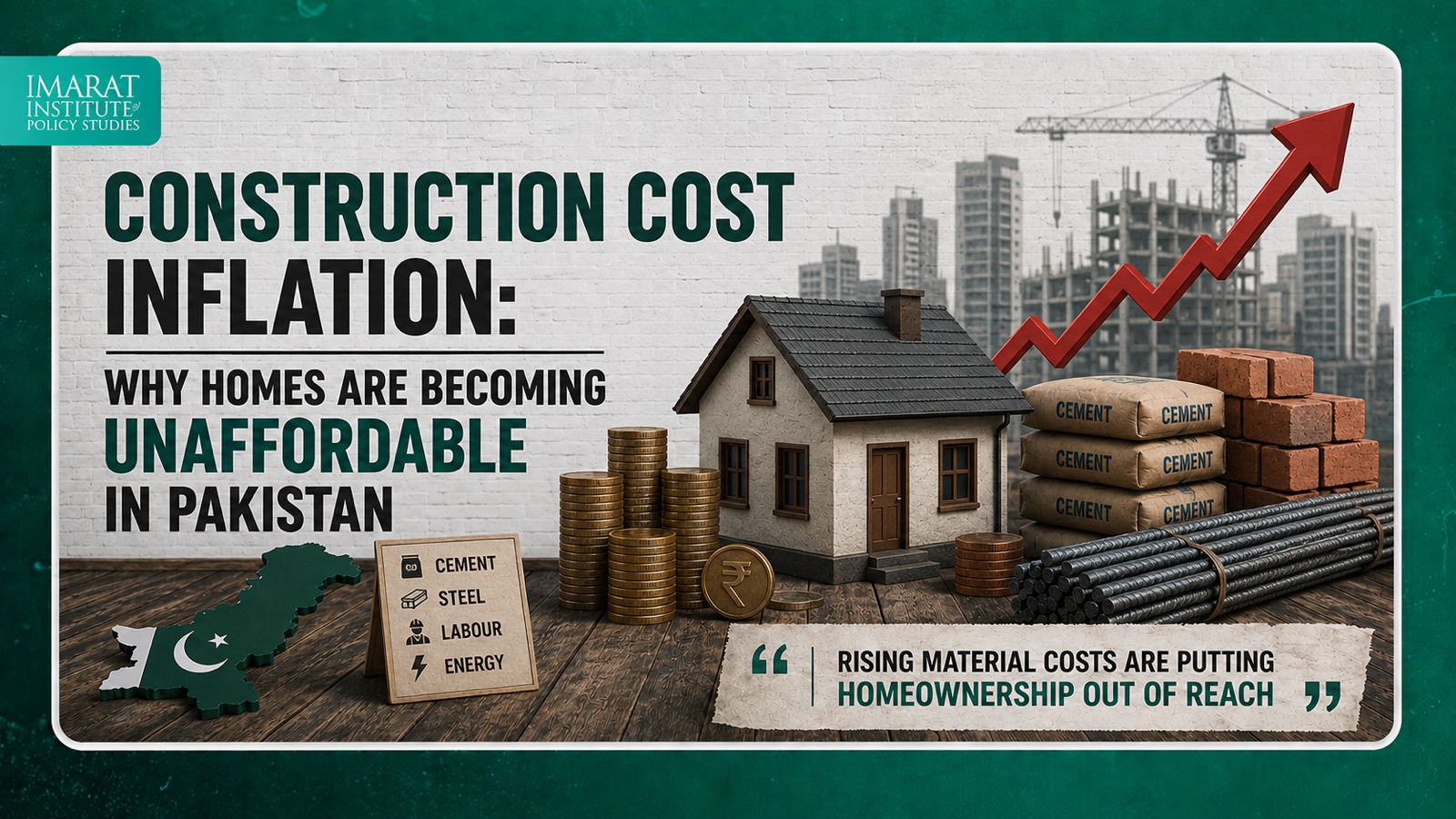
A house becomes unaffordable long before it reaches the buyer. The cost begins rising at the construction stage, where developers, contractors, and self-build families face higher prices for cement, steel, bricks, tiles, aluminium, glass, paint, wiring, plumbing, transport, labour, fuel, and financing. When construction costs rise, either the selling price increases, the project slows down, or the quality of construction is reduced.
Pakistan’s housing affordability crisis is therefore closely linked to construction cost inflation. A family that planned to build a five-marla house may delay construction because material prices rise. A developer may revise prices during a project. A contractor may cut margins or compromise quality. A low-income household may build incrementally, leaving homes incomplete for years.
Construction is a major part of the wider economy because it connects real estate, manufacturing, labour, finance, transport, cement, steel, ceramics, electrical goods, and public infrastructure. When construction becomes expensive, the effect spreads across housing, employment, industry, and urban development.
Why Construction Costs Rise
Construction cost inflation usually comes from several sources at once. The first is material prices. Cement and steel are the two most visible inputs because they form the structural backbone of most formal construction. When their prices increase, the total cost of a house rises quickly.
The second source is energy. Cement, steel, bricks, tiles, glass, and other construction materials require fuel and electricity. Higher energy costs increase manufacturing and transport expenses. These costs then move through the supply chain.
The third source is exchange-rate pressure. Imported machinery, chemicals, finishing materials, lifts, generators, solar equipment, glass, fixtures, and electrical components become more expensive when the rupee weakens. Even locally produced materials may be affected if they rely on imported fuel or inputs.
The fourth source is taxation and regulation. Duties, sales taxes, excise duties, and documentation costs can raise formal construction costs. While taxation is necessary for public revenue, sudden or poorly structured changes can disrupt project budgets.
The fifth source is financing cost. Construction projects often rely on borrowed money. When interest rates are high, developers face higher carrying costs. Projects take longer to complete, and buyers may struggle to make instalments.
Pakistan’s Construction Slowdown
Pakistan Economic Survey 2023-24 noted that the economy was recovering after a difficult period of inflation, external pressure, and tight financial conditions (Finance Division, Government of Pakistan, 2024). Construction activity is especially sensitive to these conditions because it depends on confidence, long-term investment, affordable finance, and predictable material prices.
Cement data also gives a useful signal. Market research based on APCMA data showed that Pakistan’s total cement dispatches in FY24 were around 45.3 million tons, up 2% year-on-year, but this was mainly supported by exports, while local dispatches declined by about 5% year-on-year (Arif Habib Limited, 2024). Lower domestic cement offtake can reflect weaker local construction demand, slower private building activity, and pressure on affordability.
For housing, this is significant. If local construction demand weakens while the population continues to grow, the housing shortage becomes harder to address. Projects slow down, affordability worsens, and informal construction expands.
How Cost Inflation Affects Housing Affordability
Construction cost inflation affects different groups in different ways. For developers, rising input prices reduce the ability to offer fixed prices. Many developers either increase prices during construction, delay delivery, or reduce the quality of finishing. This creates mistrust between buyers and developers.
For middle-income families, construction cost inflation changes the entire home-building plan. A family may buy a plot but delay building. Another may build only the ground floor and leave upper floors for later. Some reduce room sizes, use lower-quality materials, or avoid energy-efficient features because upfront costs are higher.
For low-income households, the impact is more severe. Families may use cheaper and weaker materials, live in unfinished structures, avoid proper sanitation, or build without technical supervision. This increases long-term safety risks, especially during floods, earthquakes, heatwaves, and heavy rainfall.
For the rental market, higher construction costs can reduce new supply. If developers cannot build affordable units profitably, fewer rental homes enter the market. Over time, rents rise in well-located areas.
The Quality Problem
One of the hidden effects of construction inflation is quality reduction. When costs rise, some builders reduce steel quantity, use lower-quality cement, ignore insulation, compromise waterproofing, install cheaper wiring, or skip proper drainage and ventilation. These compromises may not be visible at the time of purchase but can create serious problems later.
Poor quality construction increases maintenance costs. A cheaper roof may leak. Poor wiring can create fire risk. Weak waterproofing can damage walls. Bad ventilation can increase heat stress. Low-quality plumbing can cause seepage and sanitation issues.
This means affordability must be measured over the life of a building, not only at the time of purchase. A house that costs less upfront but requires constant repair may be more expensive in the long run.
Global Lessons: Reducing Cost Without Reducing Quality
Countries facing housing affordability pressure often use industrialised construction, standardised designs, bulk procurement, and better project management to reduce costs. Modular and prefabricated construction can reduce waste and improve speed when used at scale. Standardised affordable housing designs can lower architectural and approval costs. Bulk procurement of materials can reduce price volatility for large public housing programmes.
Pakistan can adapt these principles. The country does not need to replace all conventional construction, but it can introduce standardised designs for affordable housing, disaster-resilient homes, school buildings, clinics, and worker housing. Public housing programmes can negotiate material supply in bulk. Developers can use digital project management to reduce delays and wastage.
Energy-efficient design should also be treated as cost control. Proper orientation, insulation, ventilation, and shading reduce future electricity bills. A slightly higher construction cost may produce a much lower lifetime cost for residents.
What Pakistan Should Do
Pakistan needs a construction cost monitoring system. Public authorities, industry associations, and research institutions should publish regular price indices for cement, steel, bricks, labour, finishing materials, and regional construction costs. Buyers and policymakers need transparent data.
Second, affordable housing projects should use standardised, climate-responsive designs. Repeating safe and efficient designs can lower costs and improve quality.
Third, banks and housing finance institutions should support phased construction loans. Many families build gradually. Finance products should match this behaviour instead of forcing households into large one-time borrowing.
Fourth, building codes should be enforced to prevent unsafe cost-cutting. Affordability should never mean weak structures.
Fifth, local material innovation should be encouraged. Compressed earth blocks, fly ash bricks, recycled materials, and improved local materials can reduce costs in some contexts if tested and certified properly.
Conclusion
Construction cost inflation is one of the main reasons homes are becoming unaffordable in Pakistan. Rising cement, steel, energy, transport, tax, labour, and financing costs all flow into the final price of housing. When costs rise faster than incomes, families delay construction, developers increase prices, and low-income households compromise on quality.
Pakistan cannot solve its housing crisis without controlling construction cost pressures and improving productivity. The solution is not to build cheaper at the cost of safety. The solution is to build smarter: better data, standard designs, efficient materials, phased finance, bulk procurement, stronger regulation, and climate-responsive construction.
Housing affordability begins before the house is sold. It begins with how the house is designed, financed, built, regulated, and maintained. If Pakistan can reduce waste and improve construction efficiency, it can make housing more affordable without sacrificing safety or quality.
References
Arif Habib Limited. (2024). Cement dispatches: FY24. Arif Habib Limited.
Finance Division, Government of Pakistan. (2024). Pakistan Economic Survey 2023-24. Ministry of Finance.
Pakistan Bureau of Statistics. (n.d.). Price statistics and inflation data. Government of Pakistan.
State Bank of Pakistan. (2024). The state of Pakistan’s economy: Half year report 2023-24. State Bank of Pakistan.
This article is written by Rehan Zahid. Rehan is a research analyst at the Iqbal Institute of Policy Studies (IIPS).

Leave a Reply