
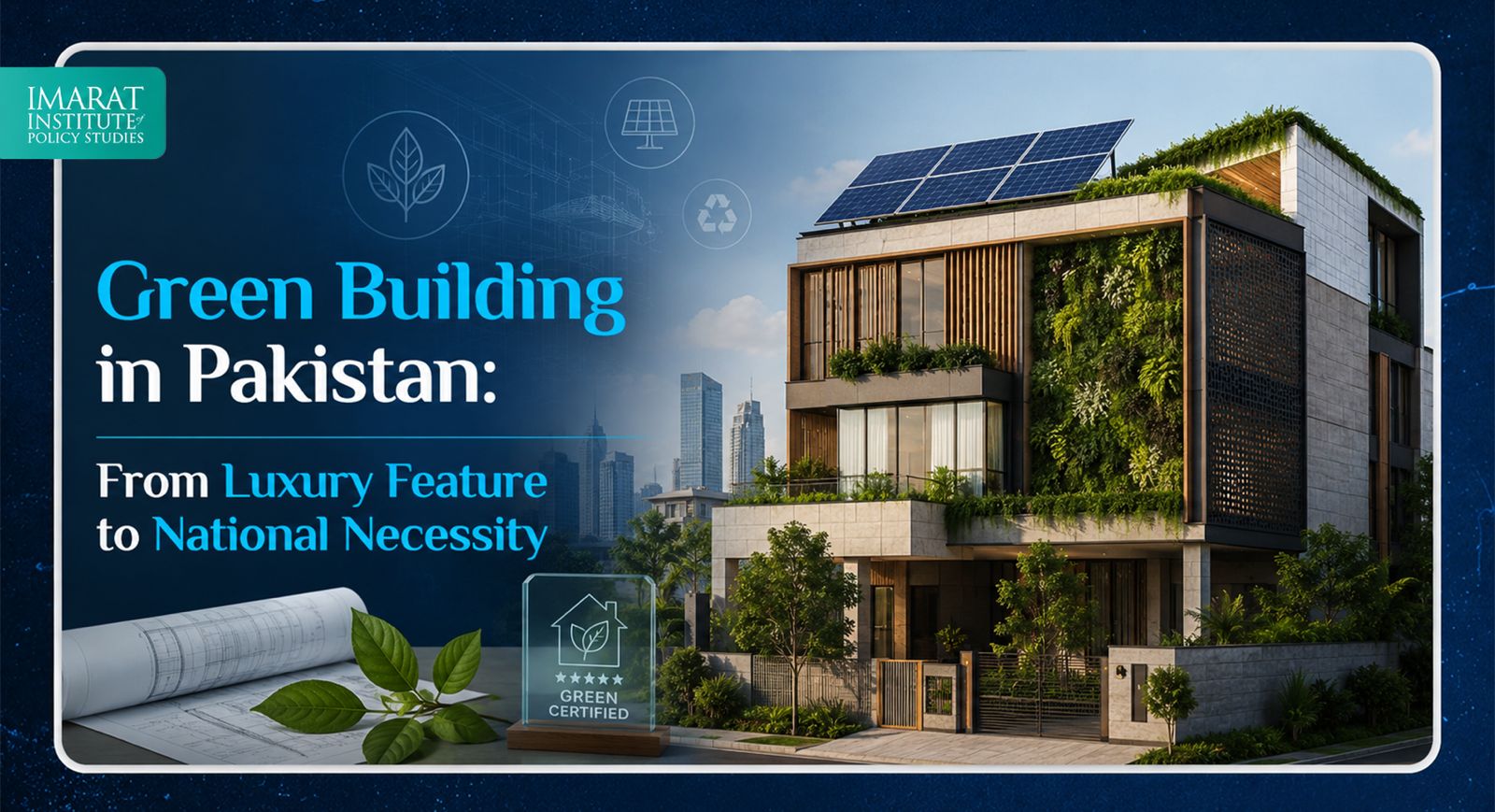
Green building is often treated as a premium feature in Pakistan’s real estate market. Developers use terms such as “eco-friendly,” “sustainable,” “smart,” and “green” to market high-end projects, but the concept is far more important than branding. For Pakistan, green building is becoming a national necessity.
Pakistan faces rising electricity demand, extreme heat, urban flooding, poor air quality, water stress, and growing construction needs. Buildings are central to all these challenges. Homes, offices, malls, hotels, schools, hospitals, and apartment blocks consume energy, water, materials, and land. If they are designed poorly, they increase cooling demand, waste resources, and make cities hotter. If they are designed well, they can reduce energy use, improve comfort, and lower long-term costs.
The Energy Conservation Building Code of Pakistan 2023 sets minimum requirements for energy-efficient design and construction of buildings, including new buildings and alterations to existing buildings and systems (National Energy Efficiency and Conservation Authority, 2023). This is an important step because green construction cannot remain voluntary marketing. It must become part of mainstream building regulation.
Why Buildings Matter for Pakistan’s Energy Future
Pakistan’s energy debate often focuses on power generation: dams, solar farms, imported fuel, transmission, tariffs, and circular debt. But demand reduction is equally important. A poorly designed building requires more cooling, lighting, and ventilation energy. A well-designed building can reduce consumption before electricity even reaches the meter.
PIDE has highlighted that the building sector is a major electricity consumer in Pakistan for space heating and cooling, refrigeration, cooking, lighting, and other uses, and that effective energy efficiency and conservation measures could save up to 2.63 million tonnes of oil equivalent in energy (PIDE, n.d.). This matters because the cheapest unit of energy is often the one that does not need to be produced.
As temperatures rise, cooling demand will become a major pressure point. Buildings with poor orientation, unshaded windows, heat-absorbing roofs, weak ventilation, and low insulation trap heat. Residents then rely more heavily on fans, air conditioners, and backup power. This increases household bills and grid stress.
Green building should therefore be understood as affordability policy. A cheaper home that produces high electricity bills is not truly affordable. Energy efficiency lowers the lifetime cost of housing.
What Green Building Actually Means
Green building is not limited to solar panels. Solar energy is valuable, but a building should first reduce demand through design. This includes orientation, shading, insulation, natural ventilation, efficient lighting, low-flow water fixtures, reflective roofs, rainwater management, and efficient materials.
In Pakistan’s climate, passive design can make a major difference. Buildings should reduce heat gain through shaded windows, cross ventilation, roof insulation, courtyards, verandas, trees, and appropriate materials. Traditional architecture in many parts of Pakistan already used climate-responsive design before modern construction replaced it with glass-heavy, heat-trapping buildings.
Green building also includes water efficiency. In cities such as Lahore, Karachi, Quetta, and Islamabad, water stress is becoming a major urban concern. Buildings should include rainwater harvesting, greywater reuse where possible, low-flow fixtures, and landscape design that does not waste water.
Material choice is another important factor. Cement and steel are essential to modern construction, but they are energy-intensive. Better design can reduce waste, encourage recycled materials, improve construction quality, and lower embodied carbon.
Global Benchmark: EDGE and Resource Efficiency
The EDGE green building certification system, developed by the International Finance Corporation, is designed for emerging markets and helps developers identify cost-effective ways to reduce energy use, water use, and embodied energy in materials (EDGE, n.d.). EDGE is relevant for Pakistan because it focuses on practical resource efficiency rather than only premium sustainability branding.
For Pakistan’s real estate sector, EDGE-style certification can help create measurable standards. Instead of claiming a project is green, developers can show quantified reductions in energy, water, and material impact. This is important for investors, buyers, tenants, and regulators.
Green certification can also support hospitality and commercial real estate. Hotels, malls, offices, and hospitals have high energy and water demand. Resource-efficient design can reduce operating costs and improve brand value, especially as international investors and corporate tenants increasingly consider sustainability performance.
The Policy Gap
Pakistan has taken steps through building energy codes, but enforcement remains the main challenge. A code is only effective if it is integrated with building approvals, inspections, architect and engineer training, municipal by-laws, and occupancy certification.
Research on building energy efficiency policies in Pakistan has noted challenges such as weak code enforcement, lack of integration with local by-laws, limited consideration of local materials, and gaps in implementation capacity (Mahar et al., 2019). This is the typical problem with urban regulation in Pakistan: strong policy documents often exist, but practical enforcement remains uneven.
To make green building mainstream, development authorities should require energy compliance at the approval stage. Architects and engineers should submit energy design checklists. Builders should document materials and systems. Large buildings should undergo energy audits. Occupancy certificates should be linked to compliance.
Green Construction and Affordable Housing
A common misconception is that green building is too expensive for affordable housing. In reality, many green measures are low-cost if included at the design stage. Proper orientation, window placement, ventilation, roof insulation, shading, and tree cover can reduce heat without major cost increases.
Affordable housing should be the first priority for green design because low-income households are most affected by high utility bills and poor thermal comfort. A poorly ventilated low-cost house can become dangerously hot in summer. A flood-prone settlement without drainage can become unliveable during heavy rain.
Government-backed housing schemes should include minimum green standards: roof insulation, natural ventilation, water-efficient fixtures, safe sanitation, solar-ready rooftops, and flood-resilient site planning. These measures improve health, comfort, and affordability.
Business Opportunity for Real Estate Developers
Green building is also a business opportunity. Buyers and tenants increasingly care about electricity bills, backup power, indoor comfort, and environmental quality. Developers who can prove lower operating costs may gain a market advantage.
For commercial developers, energy efficiency improves net operating income. Lower energy and water bills can make offices, malls, and hotels more competitive. For housing societies, solar-ready infrastructure, shaded streets, water recycling, and green public spaces can improve long-term value.
Banks can support this shift through green mortgages and construction finance. Projects that meet verified energy-efficiency standards could receive better loan terms. Homebuyers purchasing certified efficient units could be offered lower financing rates because their monthly utility burden is likely to be lower.
Conclusion
Green building in Pakistan should no longer be treated as a luxury feature for elite projects. It is a practical response to energy shortages, heat stress, rising utility costs, water scarcity, and climate risk. The Energy Conservation Building Code of Pakistan 2023 provides an important regulatory foundation, but enforcement and market adoption must now follow (National Energy Efficiency and Conservation Authority, 2023).
Pakistan’s real estate sector has a choice. It can continue building structures that increase energy demand and urban heat, or it can design buildings that are cooler, cheaper to operate, healthier, and more resilient. Green construction is not only about the environment. It is about economic efficiency, household affordability, and urban survival.
The future of construction in Pakistan should be measured not only by square feet sold, but by energy saved, water conserved, heat reduced, and comfort improved. That is where real estate value will increasingly be created.
References
EDGE. (n.d.). Green building certification. EDGE Buildings.
Mahar, W. A., Verbeeck, G., Reiter, S., & Attia, S. (2019). Building energy efficiency policies in Pakistan: Current issues and prospects. Energy Policy, 129, 879-894.
National Energy Efficiency and Conservation Authority. (2023). Energy Conservation Building Code of Pakistan: Energy provisions 2023. Government of Pakistan.
Pakistan Institute of Development Economics. (n.d.). Energy efficient buildings to save energy in Pakistan. PIDE.
This article is written by Rehan Zahid. Rehan is a research analyst at the Iqbal Institute of Policy Studies (IIPS).

Leave a Reply