
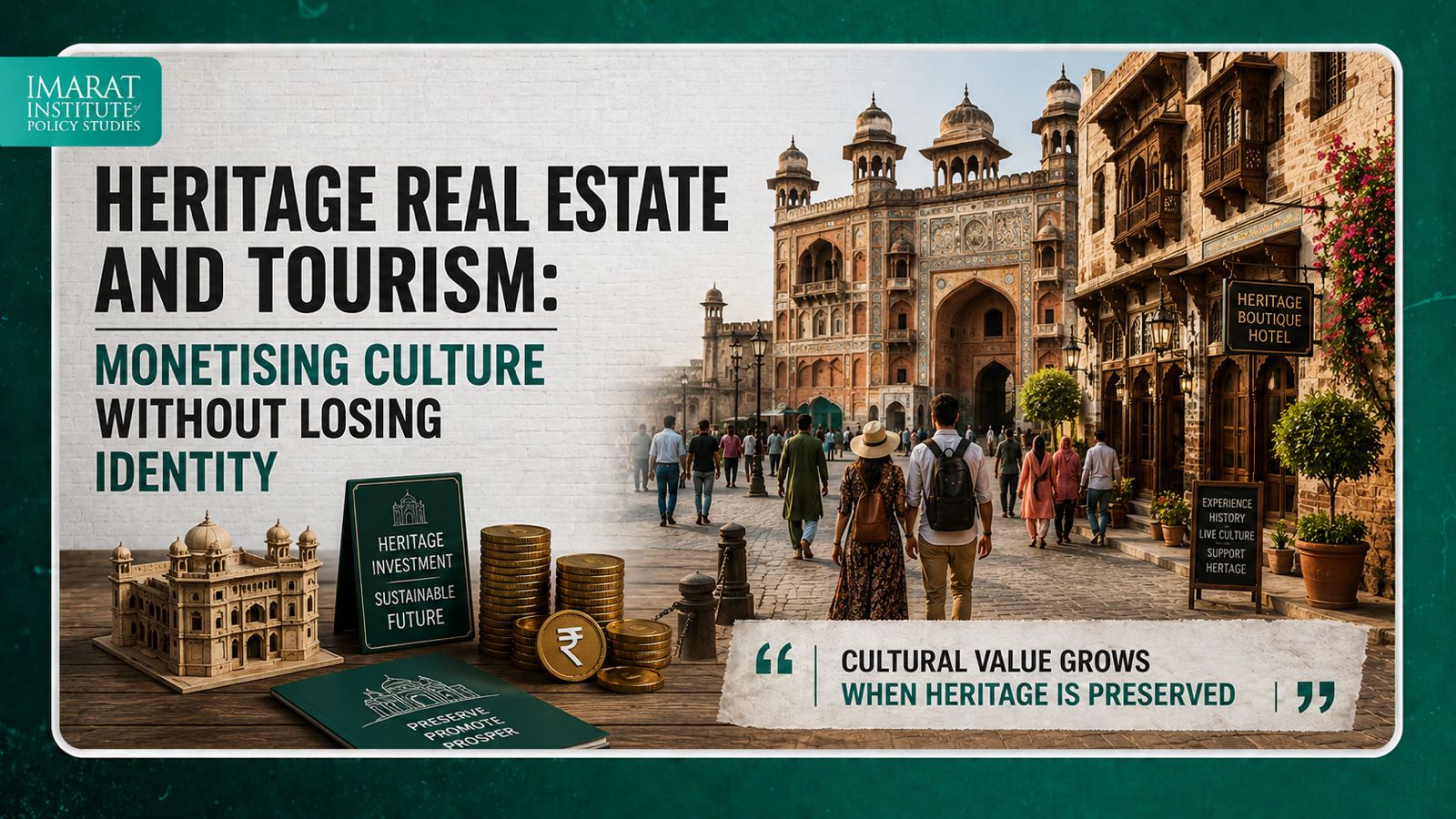
Pakistan’s cities are full of historic value. Lahore, Multan, Peshawar, Taxila, Thatta, Hyderabad, Bahawalpur, Karachi, and many smaller towns contain mosques, forts, shrines, havelis, colonial buildings, bazaars, gates, streets, gardens, tombs, and craft traditions that can support tourism and local economic growth. Yet heritage is often treated as either a frozen monument or a neglected liability.
A better approach is heritage-led regeneration. This means using conservation, tourism, public space, local business, and adaptive reuse to revive historic areas without destroying their identity. Properly managed heritage real estate can create jobs, attract visitors, support hospitality, raise local incomes, and strengthen city branding. Poorly managed commercialisation can do the opposite: displace residents, damage buildings, create traffic, and turn living culture into artificial decoration.
The World Bank has highlighted the Walled City of Lahore as an example where improving livelihoods and preserving heritage can go together. The Walled City of Lahore Authority, supported by a World Bank project and technical support from the Aga Khan Trust for Culture, worked to restore historic neighbourhoods while addressing infrastructure and urban management challenges (World Bank, 2013). This is a useful model because it treats heritage as a living urban system, not only as old architecture.
Why Heritage Matters Economically
Heritage creates value in several ways. First, it attracts tourists. Visitors travel for history, architecture, food, crafts, festivals, religious sites, and authentic urban experiences. Second, it supports small businesses such as restaurants, tour guides, souvenir shops, transport services, guest houses, photographers, artisans, and cultural performers. Third, it improves city identity. A city with a strong cultural brand attracts more attention, investment, and civic pride.
Fourth, heritage buildings can be reused. Old havelis, warehouses, colonial structures, and traditional houses can become boutique hotels, museums, cafés, galleries, libraries, craft centres, co-working spaces, or educational institutes. Adaptive reuse is often more sustainable than demolition because it preserves embodied materials and cultural memory.
However, heritage real estate must be managed carefully. If land values rise too quickly, original residents and small businesses may be pushed out. If commercial signage, illegal construction, and traffic are not controlled, heritage streets lose their character. If restoration is done without technical expertise, buildings can be permanently damaged.
Lahore Walled City: A Local Benchmark
The Walled City of Lahore is one of Pakistan’s strongest examples of heritage-led urban renewal. The Aga Khan Development Network states that the Aga Khan Trust for Culture, in partnership with the Government of Punjab and the World Bank, has helped revitalise the Walled City of Lahore (Aga Khan Development Network, 2022). Walled City of Lahore Authority’s own material notes that the Sustainable Development of Walled City Lahore Project was launched by the World Bank with the Government of Punjab in 2006, and that Aga Khan Trust for Culture was brought on board in 2007 for execution and technical assistance (Walled City of Lahore Authority, n.d.).
This matters because heritage regeneration is not only about restoring buildings. It also involves infrastructure, streets, residents, utilities, economic activity, and tourism management. The Walled City experience shows that heritage areas need institutions, documentation, technical expertise, and long-term investment.
The restoration of Shahi Hammam further demonstrates this. Aga Khan Development Network reported that the conservation of the 17th-century Shahi Hammam in Lahore received the UNESCO Asia-Pacific Award of Merit for Cultural Heritage Conservation in 2016 (Aga Khan Development Network, 2016). Such recognition shows that Pakistan has the capacity to deliver internationally respected conservation when projects are well managed.
Global Lessons for Pakistan
Internationally, heritage regeneration succeeds when conservation and local life are balanced. Istanbul, Marrakech, George Town in Malaysia, and parts of Europe show that historic districts can become strong tourism assets. But they also show the risk of over-commercialisation. When heritage areas become too tourist-focused, rents rise, local residents leave, and daily culture becomes staged for visitors.
Pakistan should avoid this mistake. The goal should not be to turn historic cities into theme parks. The goal should be to improve living conditions, preserve architecture, support local businesses, and welcome visitors without erasing community life.
This requires a clear distinction between adaptive reuse and destructive conversion. Turning an old building into a boutique hotel may be positive if the structure is preserved, local workers benefit, and public access is respected. Demolishing heritage interiors to create generic commercial space is not regeneration. It is cultural loss.
Heritage, Housing, and Local Residents
One of the biggest mistakes in heritage planning is ignoring residents. Many historic districts are still living neighbourhoods. People cook, pray, work, study, shop, and raise families there. If conservation only serves tourists, residents may see heritage as a burden rather than an asset.
Heritage improvement should include better drainage, sanitation, electricity, waste collection, fire safety, street lighting, and pedestrian access. Residents should benefit from tourism through jobs, shop improvements, home-based enterprises, guided tours, food businesses, handicrafts, and rental income.
Regeneration should also protect low-income residents from displacement. If restored districts become too expensive, the communities that preserved them through everyday life may be forced out. Rent controls, resident protections, grants for home repair, and community business support can help prevent this.
Policy Recommendations
Pakistan should create heritage economic zones in selected historic districts. These zones should combine conservation rules, tourism planning, local business support, and infrastructure upgrades.
Second, adaptive reuse guidelines should be introduced. Owners should know how to convert heritage buildings safely without destroying original features.
Third, heritage tourism revenue should be reinvested locally. Ticketing, parking, licensing, and tourism fees should support sanitation, street repair, public toilets, signage, and conservation.
Fourth, local residents and artisans should be included in planning. Heritage belongs not only to visitors and investors, but to communities.
Fifth, cities should create digital heritage inventories. Mapping buildings, ownership, condition, risk, and tourism potential can improve planning and reduce illegal demolition.
Conclusion
Pakistan’s heritage is not only a memory of the past. It is an economic and cultural asset for the future. Historic districts can support tourism, hospitality, real estate, small businesses, and city branding if they are managed with care.
The Walled City of Lahore shows that heritage regeneration is possible when institutions, conservation experts, public investment, and community life are connected. The recognition of Shahi Hammam by UNESCO also proves that Pakistan can meet international conservation standards.
The challenge now is to scale this thinking beyond isolated monuments. Pakistan should treat heritage real estate as living urban heritage. Commercial value can be created, but not at the cost of identity. The goal must be to monetise culture without losing the culture itself.
References
Aga Khan Development Network. (2016). 17th century Shahi Hammam wins UNESCO Asia-Pacific Award for Cultural Heritage Conservation. AKDN.
Aga Khan Development Network. (2022). The Walled City of Lahore: Preserving heritage and catalysing renewal. AKDN.
Walled City of Lahore Authority. (n.d.). About WCLA: Preserving Lahore’s Walled City heritage. Government of Punjab.
World Bank. (2013). In Lahore, improving livelihoods and preserving heritage go hand in hand. World Bank.
This article is written by Rehan Zahid. Rehan is a research analyst at the Iqbal Institute of Policy Studies (IIPS).

Leave a Reply