
Introduction
Water is becoming one of Pakistan’s most serious urban challenges. In some places, cities flood after heavy rain. In others, groundwater is falling because extraction is faster than recharge. Many housing societies depend on tube wells, while stormwater is treated as a nuisance to be drained away as quickly as possible. This approach is no longer sustainable.
Water-sensitive urban design offers a better model. It treats rainwater, drainage, groundwater recharge, wastewater, landscaping, and urban design as one connected system. Instead of building cities that push water away, it builds cities that absorb, store, reuse, and manage water intelligently.
This matters for Pakistan because urban flooding and groundwater stress are both increasing. The World Bank’s work on groundwater in Pakistan’s Indus Basin highlights the importance of groundwater for domestic, municipal, agricultural, and industrial use, while also identifying groundwater stress and management weaknesses (World Bank, 2021). Lahore’s groundwater decline has also been the subject of recent research, with studies showing falling groundwater levels in parts of the city and warning that alternative water sources are needed to protect deep aquifers (Raza et al., 2025).
For real estate and construction, this creates a clear message: future housing societies, apartment projects, commercial districts, and public infrastructure must be designed around water efficiency and flood resilience.
Why Conventional Urban Drainage Is Failing
Traditional drainage planning treats rainwater as waste. Water falls on roofs, roads, parking areas, and paved streets, then flows into drains and nullahs. If drains are blocked, undersized, or poorly maintained, urban flooding occurs. If too much land is paved, less water enters the ground. If housing societies expand without drainage planning, stormwater moves into surrounding communities.
This is a common problem in Pakistani cities. Rapid construction replaces open land with concrete. Natural drainage paths are encroached upon. Nullahs become dumping sites. Roads are built without adequate stormwater systems. Housing schemes raise their own land levels and push water into neighbouring areas. The result is localised flooding, road damage, property loss, and public health risks.
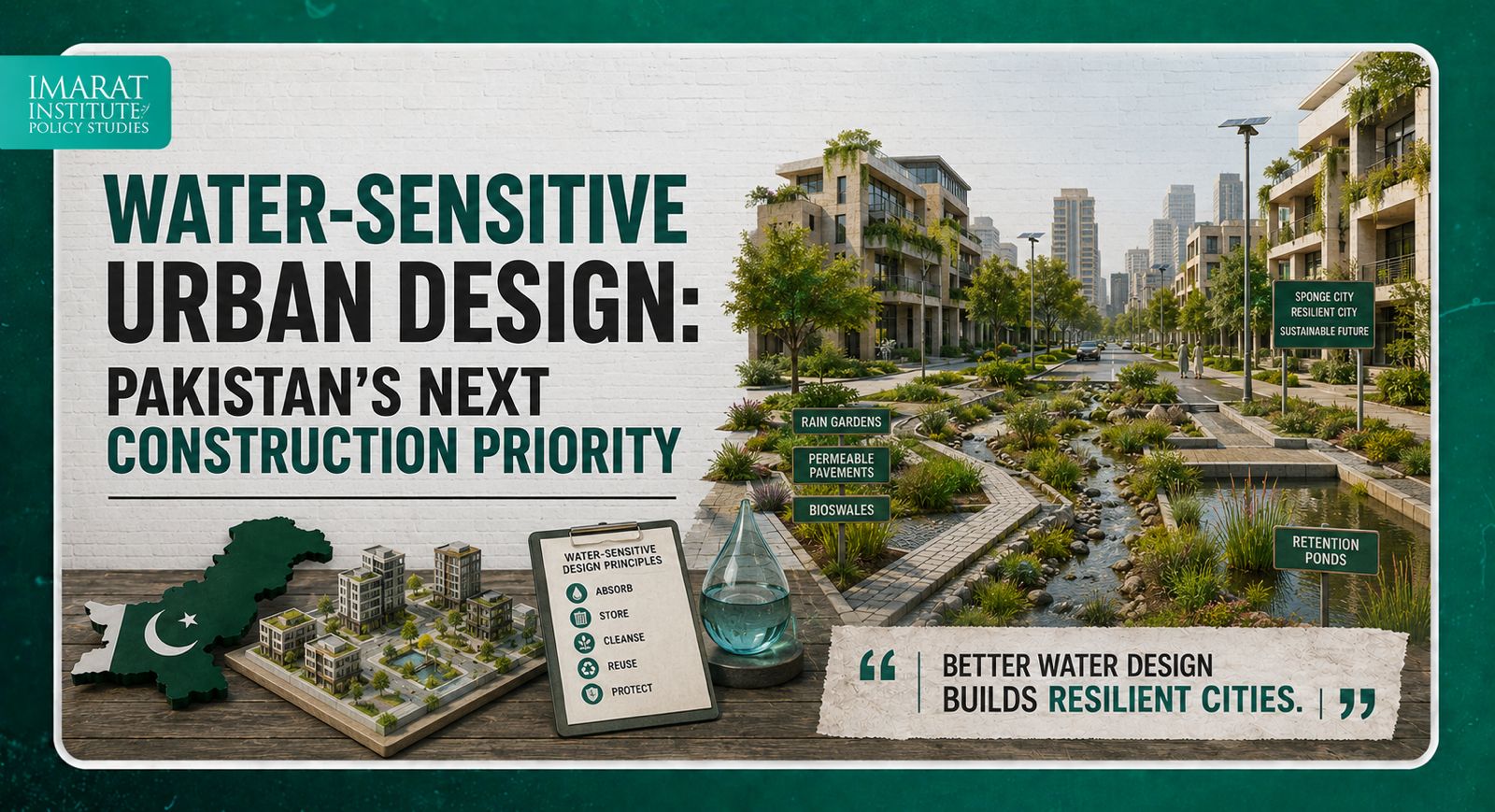
Water-sensitive design changes this logic. It asks how water can be slowed, filtered, absorbed, reused, and safely released. This includes rain gardens, bioswales, permeable pavements, detention ponds, recharge wells, green roofs, wetlands, water channels, tree pits, and landscaped drainage corridors.
Global Benchmark: Singapore’s ABC Waters Programme
Singapore provides a useful example through its Active, Beautiful, Clean Waters programme. PUB, Singapore’s National Water Agency, describes the ABC Waters Programme as an effort to create attractive waterscapes and community spaces around waterways, with features such as lookout decks and pedestrian bridges that encourage walking, jogging, and cycling (PUB Singapore, n.d.).
The programme shows that water infrastructure does not have to be hidden or treated only as engineering. Drains, canals, ponds, and reservoirs can become public spaces that improve liveability. Singapore’s National Library Board notes that the programme was launched in 2006 with two objectives: improving water quality and enhancing liveability (National Library Board Singapore, 2025).
For Pakistan, the lesson is not to copy Singapore’s expensive infrastructure. The lesson is to integrate water management into urban design. Nullahs, retention ponds, drains, and stormwater channels should not be neglected back-end systems. They should be planned as safe, clean, and functional public assets.
Global Benchmark: China’s Sponge Cities
China’s Sponge City programme is another important example. The Asian Development Bank explains that the programme uses nature-based solutions and green infrastructure such as wetlands, water-retention parks, rain gardens, bioswales, pervious pavement, and green roofs to improve water management and reduce urban runoff and flooding (Asian Development Bank, 2022).
The World Bank has also described China’s sponge city approach as part of integrated urban flood management using green, blue, and gray infrastructure (World Bank, 2021). The core idea is simple: cities should act more like sponges. They should absorb and store rainfall rather than pushing all water into drains at once.
Pakistan’s cities can adapt this principle at a smaller and more affordable scale. Housing societies can require rainwater harvesting. Commercial plazas can use permeable parking. Parks can double as detention basins. Streets can include bioswales. Apartment buildings can collect roof water. Mosques, schools, and community centres can install recharge wells where technically safe.
Water-Sensitive Real Estate
Water-sensitive design should become part of real estate value. Buyers already ask about roads, security, parks, electricity, and location. They should also ask: Does the project flood during rain? Where does stormwater go? Is groundwater being recharged? Does the society recycle water for landscaping? Are drains maintained? Is the project built on a natural drainage path?
Developers who answer these questions well will have a competitive advantage. A housing society with proper drainage, rainwater systems, water-efficient landscaping, and flood-safe roads will hold long-term value better than one that floods every monsoon.
Water-sensitive design also reduces operating costs. Reused greywater can irrigate green spaces. Rainwater harvesting can reduce dependence on groundwater. Native plants can reduce landscape water demand. Permeable surfaces can reduce drainage pressure.
What Pakistan Should Do
Pakistan should introduce water-sensitive design requirements in building and housing society approvals. Large projects should submit stormwater management plans, groundwater recharge assessments, drainage impact studies, and water-use estimates.
Second, housing societies should not be approved without detention areas, drainage corridors, and safe outfalls. A project should not solve its own drainage by pushing water onto neighbouring communities.
Third, cities should protect natural drainage channels. Nullahs should be mapped, cleared, restored, and protected from construction and dumping.
Fourth, rainwater harvesting should be required for large roofs, schools, mosques, commercial buildings, and public offices where technically suitable.
Fifth, urban parks should be designed as water infrastructure. Parks can temporarily hold stormwater during heavy rain and serve as public spaces during dry periods.
Conclusion
Pakistan’s urban future depends on how cities manage water. Flooding, groundwater depletion, blocked drains, and wasteful landscaping are not separate problems. They are symptoms of water-insensitive urbanisation.
Water-sensitive urban design offers a practical solution. It connects construction, drainage, groundwater recharge, public space, and climate resilience. Global examples from Singapore and China show that water infrastructure can improve both safety and liveability.
For Pakistan, the priority is clear. Every new housing society, apartment project, commercial district, and public building should be designed with water in mind. The cities that survive future climate pressure will not be the ones that simply build more concrete. They will be the ones that learn how to live with water.
References
Asian Development Bank. (2022). Sponge cities: Integrating green and gray infrastructure to build climate change resilience in the People’s Republic of China. Asian Development Bank.
National Library Board Singapore. (2025). Active, Beautiful, Clean Waters Programme. Government of Singapore.
PUB Singapore. (n.d.). ABC Waters. Singapore’s National Water Agency.
Raza, M., et al. (2025). Sustainable management of urban groundwater in Lahore central business district using GIS-based interpolation methods. Water Cycle, 6, 1-12.
World Bank. (2021). Groundwater in Pakistan’s Indus Basin: Present and future prospects. World Bank.
World Bank. (2021). Nature-based solutions in China: Financing sponge cities for integrated urban flood management. World Bank.
This article is written by Shahmeer Adnan Baloch. Shahmeer is a research analyst at the Iqbal Institute of Policy Studies (IIPS).

Leave a Reply