
Construction ranks among the prominent industries responsible for a significant carbon footprint. With the pressing need to address climate change and its far-reaching consequences, this industry stands at the forefront of transformative change. As a result, sustainable construction, once a niche concept, has evolved into an imperative for the future. This paradigm shift is driven by a profound understanding of the industry’s enormous environmental footprint and a collective commitment to build a better, greener tomorrow. However, sustainability in the construction industry is not universally embraced, with many countries still lagging behind in adopting eco-friendly practices. The challenges are multifaceted, ranging from resistance to change within the industry to varying regulations and insufficient awareness about the long-term benefits of sustainable construction. To accelerate progress, governments should prioritize sustainability through policy incentives, stringent building codes, and public awareness campaigns. Offering tax breaks for sustainable building practices, mandating green certifications, and investing in sustainable construction research can motivate both the industry and citizens to adopt more environmentally responsible practices. By leading the charge toward sustainability, governments can pave the way for a greener, more resilient construction sector and a healthier planet.
The Urgency of Sustainable Construction
The urgency of sustainable construction cannot be overstated. Buildings presently account for 39% of global energy-related carbon emissions, with 28% stemming from operational energy use and the remaining 11% from materials and construction (Worldgbc, 2019). Furtehrmore, worldwide, both in developed and developing nations, buildings account for 33% of greenhouse gas (GHG) emissions and 40% of global energy consumption, encompassing equipment usage, building material manufacturing, and transportation. In 2009, the construction sector’s total CO2 emissions reached 5.7 billion tons, constituting 23% of global economic activity emissions. As the global urban population is projected to surpass six billion by 2045, this trend may result in increased construction activities in the future. The following points highlight why there is an urgent need for sustainable construction:
Reducing Carbon Footprint
Sustainable construction seeks to minimize carbon emissions by optimizing resource use, adopting renewable materials, and improving energy efficiency. Green buildings have the potential to reduce carbon emissions by up to 35% (Ahmed et al., 2021).
Resource Scarcity
Traditional construction methods often lead to the depletion of finite resources. As per the World Watch Institute, the industry annually consumes 40% of the world’s raw stones, gravel, and sand, along with 25% of its virgin wood (Dobrowolska, 2021). Moreover, the worldwide construction materials market is expected to expand from $1,320.01 billion in 2023 to $1,729.62 billion by 2030, with a compound annual growth rate (CAGR) of 3.9% (fortunebusinessinsights, 2023). Sustainable construction, on the other hand, prioritizes the use of renewable and recyclable materials, which is essential for the long-term viability of the industry.
Urbanization and Population Growth
It is estimated that by 2050, 68% of the global population will reside in urban areas, marking an increase from 54% in 2016 (Ritchie & Roser, 2019). With rapid urbanization and population growth, the demand for new buildings and infrastructure is soaring. This presents a unique opportunity to implement sustainable practices from the outset, preventing the lock-in of unsustainable structures.
Innovative Sustainable Practices
The future of sustainable construction hinges on innovative practices that challenge conventional norms. Here are some noteworthy trends:
Green Building Certifications
Certifications like LEED (Leadership in Energy and Environmental Design) and BREEAM (Building Research Establishment Environmental Assessment Method) are becoming standard in the industry. They assess a building’s environmental impact and encourage sustainable design and construction.
Prefabrication and Modular Construction
Prefabrication and modular construction reduce waste and energy use while increasing construction speed. Modular construction can lead to an impressive 83.2% reduction in total waste weight, resulting in a significant 47.9% reduction in waste costs for large structures (Loizou et al., 2021). This trend is gaining momentum as it allows for precise manufacturing of building components in controlled environments.
Smart Buildings
The integration of technology in buildings is revolutionizing energy management. Smart buildings use sensors and automation to optimize energy consumption, lighting, and temperature, resulting in significant resource savings. A Smart Building with integrated systems is estimated to achieve approximately 30-50% savings compared to conventional buildings (Vadruccio et al., 2023).
Green Roofs and Walls
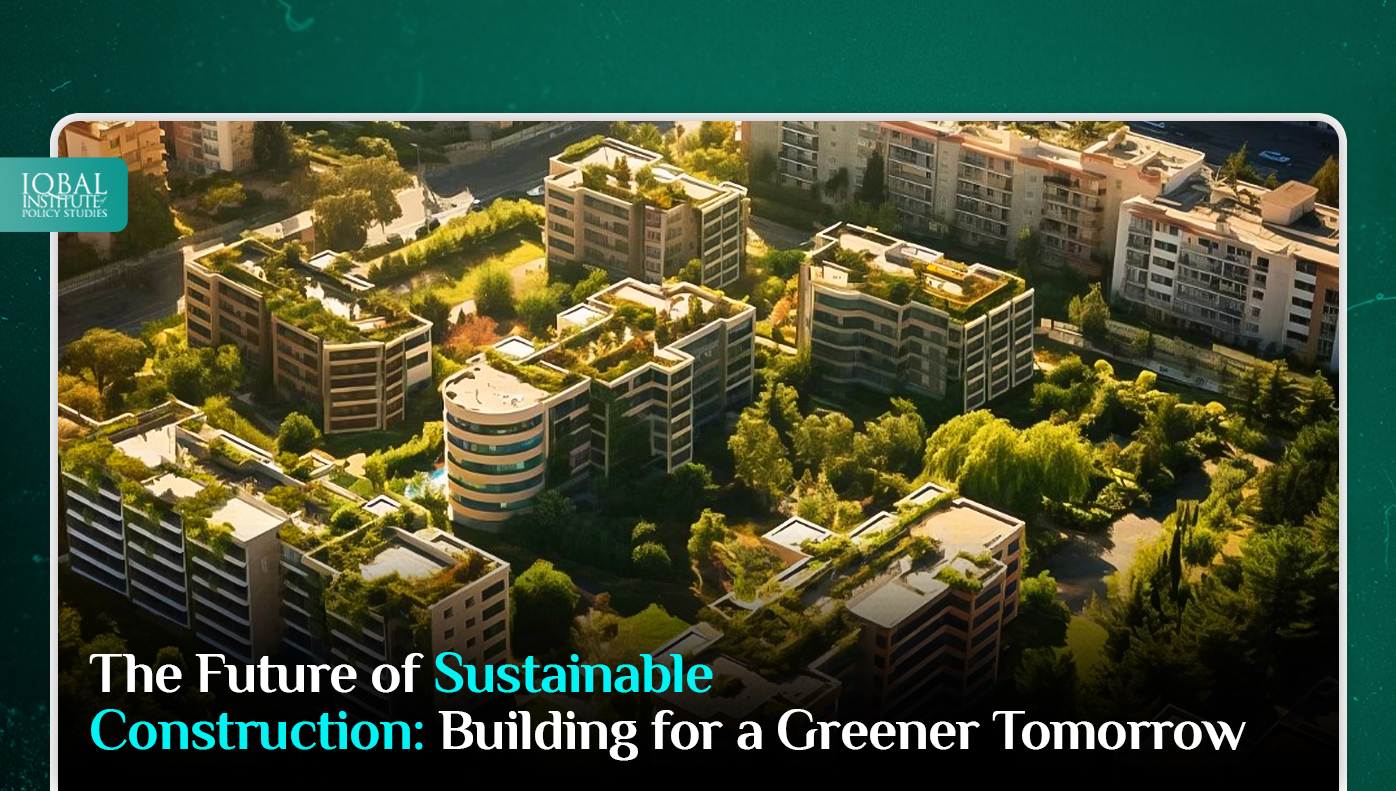
Green roofs and walls not only enhance the aesthetics of a building but also provide insulation and reduce the urban heat island effect. They contribute to biodiversity and improve air quality. According to a study, green roofs can lead to a substantial reduction in air pollution, ranging from 30% to 57% (University of Surrey, 2020).
Circular Construction
Circular construction aims to reduce waste by designing buildings with materials that can be easily reused or recycled at the end of their life cycle. This approach promotes the concept of a circular economy within the construction industry.
Energy-Efficient Design
Passive design principles, such as optimizing building orientation, natural lighting, and ventilation, are gaining prominence. These strategies reduce the need for mechanical heating and cooling, cutting energy consumption.
The Role of Technology
Technology is a driving force behind the future of sustainable construction. It empowers the industry to be more efficient, cost-effective, and environmentally responsible.
Building Information Modeling (BIM)
BIM is revolutionizing project management and design. It allows for precise planning, reduces errors, and facilitates collaboration among various stakeholders. This leads to efficient resource use and better overall sustainability.
3D Printing
3D printing technology is making waves in construction. It enables the creation of complex structures using less material waste. The ability to print with eco-friendly materials further enhances its sustainability.
Renewable Energy Integration
Incorporating renewable energy sources like solar panels and wind turbines into building design is becoming more accessible and cost-effective. These sources can significantly reduce a building’s reliance on non-renewable energy.
IoT and Data Analytics
The Internet of Things (IoT) allows for real-time monitoring and optimization of building systems. Data analytics help identify energy inefficiencies and areas for improvement, ultimately reducing resource consumption.
Blockchain for Supply Chain Transparency
Blockchain technology can enhance transparency in the supply chain, ensuring that sustainable materials are sourced and tracked accurately, reducing the risk of illegal logging or unethical practices.
Challenges and Roadblocks
While the future of sustainable construction is promising, it is not without its challenges.
Cost
Sustainable construction can be more expensive upfront, although the long-term operational savings often outweigh the initial investment.
Resistance to Change
The construction industry has deep-rooted traditions and practices that are resistant to change. Convincing stakeholders to adopt sustainable methods can be challenging.
Lack of Skilled Labor
The industry requires a skilled workforce trained in sustainable practices. A shortage of such labor can slow down the adoption of sustainable construction.
Regulatory Hurdles
Regulations and building codes vary across regions. Harmonizing these standards to encourage sustainable practices can be complex.
Technological Advancements
While technology is a boon, it can also be a barrier. Smaller firms may struggle to keep up with rapid advancements, leading to a technological divide.
What are the Solutions?
Governments play a pivotal role in promoting sustainable construction. Many countries have already implemented or are considering policies and incentives to encourage sustainability:
Tax Incentives
Tax breaks for sustainable building practices or energy-efficient technologies incentivize construction companies and individuals to adopt greener approaches.
Mandatory Green Building Standards
Some regions are making it mandatory for new construction projects to meet certain green building standards, ensuring sustainability is not just an option but a requirement.
Research Funding
Governments are investing in research and development to foster innovation in sustainable construction technologies and materials.
Eco-Friendly Procurement
Public procurement policies that prioritize sustainable materials can drive demand for greener construction practices.
Education and Training
Governments are investing in education and training programs to develop a skilled workforce capable of implementing sustainable construction practices.
Conclusion
The future of sustainable construction is not just a vision; it is a necessity. As climate change accelerates, stakeholders and policy makers commitment to building a more sustainable world must intensify. The construction industry, long seen as a culprit in environmental degradation, now has the opportunity to become a catalyst for positive change. Innovative practices, technology, and government policies are paving the way for a greener construction sector. However, challenges remain, and it is imperative that goverments address them collectively. The future of sustainable construction is not only about creating environmentally friendly buildings; it is about transforming an entire industry and, in turn, our planet’s future. By building sustainably today, we are laying the foundation for a brighter, more sustainable tomorrow.
References
Ahmed, N., Hamid, M. A., Razek, M. M. A.-E., & Dash, K. M.E. (2021, June 12). Impact of sustainable design in the construction sector on climate change. Science Direct, 12(2), 1375-1383. https://doi.org/10.1016/j.asej.2020.11.002
Dobrowolska, K. (2021, March 4). How Does Construction Affect The Environment? Archdesk. Retrieved August 29, 2023, from https://archdesk.com/blog/how-does-construction-affect-the-environment/
fortunebusinessinsights. (2023, April). Construction Materials Market Size | Global Industry Report 2030. Fortune Business Insights. Retrieved August 29, 2023, from https://www.fortunebusinessinsights.com/construction-materials-market-107415
Loizou, L., Shen, X., Barati, K., & Li, B. (2021). (PDF) Quantifying Advantages of Modular Construction: Waste Generation. ResearchGate. Retrieved August 29, 2023, from https://www.researchgate.net/publication/356876010_Quantifying_Advantages_of_Modular_Construction_Waste_Generation
Ritchie, H., & Roser, M. (2019, November). Urbanization. Our World in Data. Retrieved August 29, 2023, from https://ourworldindata.org/urbanization#what-share-of-people-will-live-in-urban-areas-in-the-future
University of Surrey. (2020, December 14). Green walls, roofs and screens can improve air quality in street canyons, finds a new review. University of Surrey. Retrieved August 29, 2023, from https://www.surrey.ac.uk/news/green-walls-roofs-and-screens-can-improve-air-quality-street-canyons-finds-new-review
Vadruccio, R., Siragusa, C., & Tumino, A. (2023). Increasing energy efficiency in Smart Building through Internet of Things retrofitting intervention. Procedia Computer Science, 263–270. https://www.sciencedirect.com/science/article/pii/S1877050923002971
Worldgbc. (2019). Embodied Carbon. World Green Building Council. Retrieved August 29, 2023, from https://worldgbc.org/advancing-net-zero/embodied-carbon/
This article is written by Haneen Gul. Haneen is a research analyst at the Iqbal Institute of Policy Studies (IIPS).

Leave a Reply